
Top 10 Countries for Women to Study Abroad
Contents
- 1 Introduction — Why Focus Specifically on “Study Abroad for Female Students”?
- 2 Methodology
- 3 Charts
- 4 Ranking (Comprehensive Scoring, Listed from Highest to Lowest)
- 5 In-Depth Analysis per Country
- 6 Trend Observations (Particularly Important for Female International Students)
- 7 For Female Students Preparing to Study Abroad — Practical Checklist (Before Departure and While Abroad)
- 8 Data Sources
Introduction — Why Focus Specifically on “Study Abroad for Female Students”?

Studying abroad is an educational choice, but for many female students, choosing a destination also involves considerations of safety, gender equality, social support, and career pathways. A rational choice requires considering both hard indicators (university rankings, tuition fees, visas) and soft indicators (nighttime travel safety, gender-friendly campuses, mechanisms for addressing sexual harassment/gender-based violence). This article attempts to combine these factors into a more female-friendly “study destination rating,” providing female readers who wish to study abroad with a warm and solid reference. UNESCO’s research on education and gender, as well as female safety/inclusivity indices, are important bases for this article.
Methodology
To ensure the conclusions are both data-supported and close to the actual concerns of female students, this ranking adopts a multi-dimensional weighted scoring system, with clear weights and data sources:
Indicators and Weights (Total Score 100)
Safety and Gender Equality (WPS / Global Peace / Gender Gap): 30%. (Data sources: WPS Index, Global Peace Index, WEF Gender Gap)
Education Quality (University Rankings / Subject Strengths / Proportion of English-Taught Programs): 25%. (Data sources: QS / THE / OECD “Education at a Glance”)
Cost and Scholarships (Tuition Levels, Cost of Living, Availability of Scholarships for International Students): 20%. (Data sources: National Education Bureaus / StudyPortals / Education Platform Compilations)
Visa and Post-Graduation Work Opportunities (Post-Study Work / Immigration Friendliness): 15%. (Data sources: National Immigration Bureaus / Policy Compilations)
Campus/Community Support (Female-Specific Support Services, Student Clubs, Mental Health): 10%. (Sources: University Official Service Pages, International Student Service Surveys)
Ranking Criteria
Only countries that are open to international students, have significant intake, and perform balancedly on the above indicators are included. Data is primarily based on publicly available materials from 2023–2025, cross-checked with multiple authoritative sources (UNESCO, OECD, WPS, QS, official education/immigration websites, and student safety guide compilations).
Transparency Reminder
Any ranking carries a certain degree of subjective weighting (for example, “safety” is weighted higher based on the common concerns of female students).
Charts
Radar Chart (Each Country’s Score on 5 Dimensions)
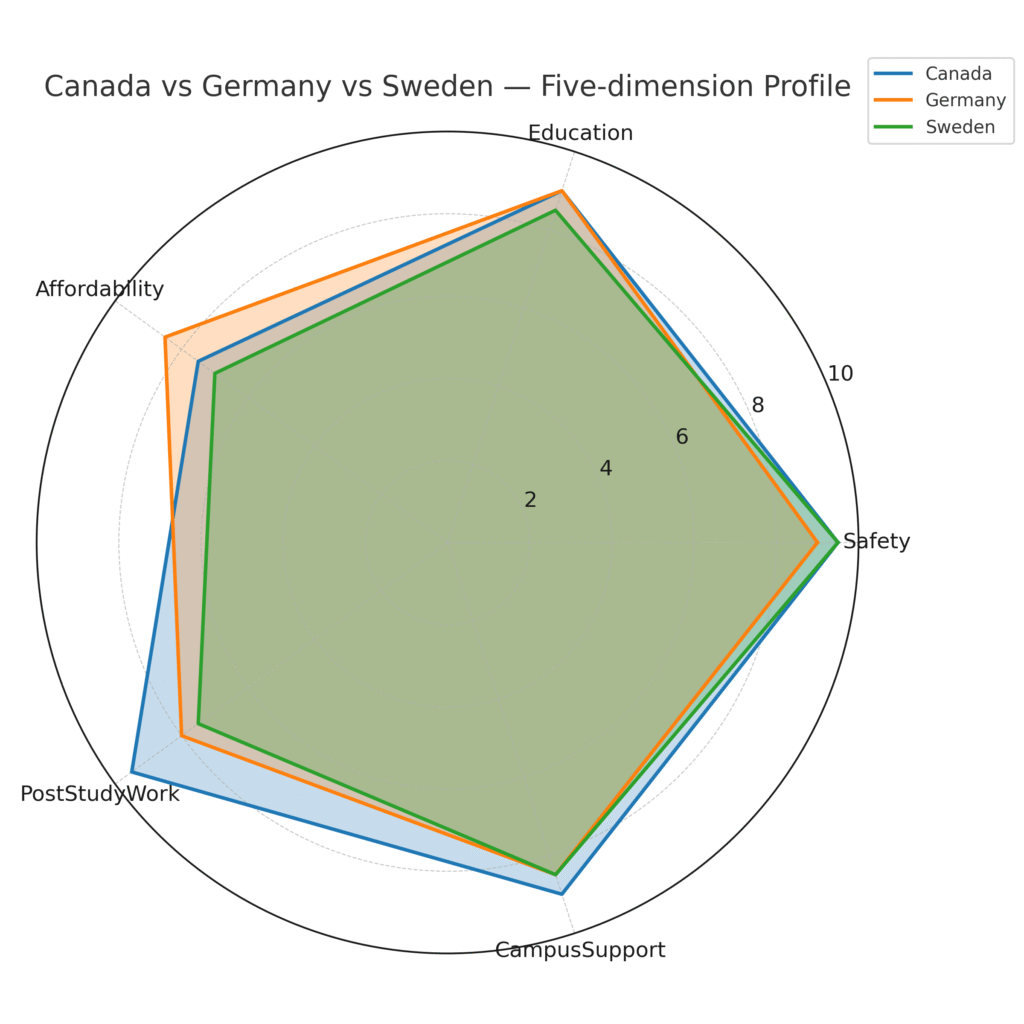
— A single chart to see where each country is strong and weak across dimensions.
Bar Chart (Comprehensive Score Ranking)
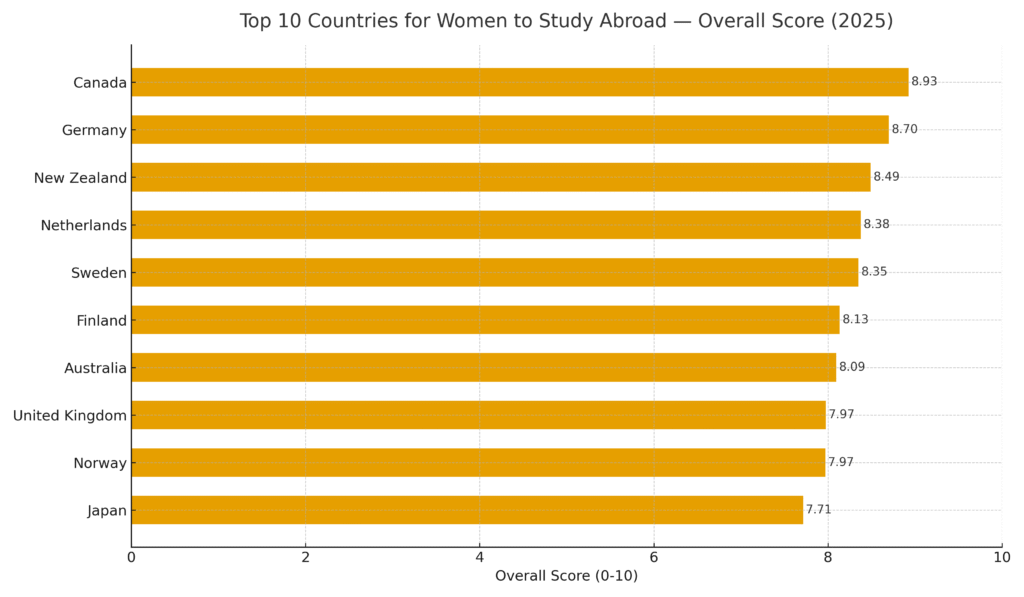
— Clearly displays the Top10 ranking and scores.
Safety and Gender Equality Comparison Chart (WPS / Global Peace Index Side by Side)
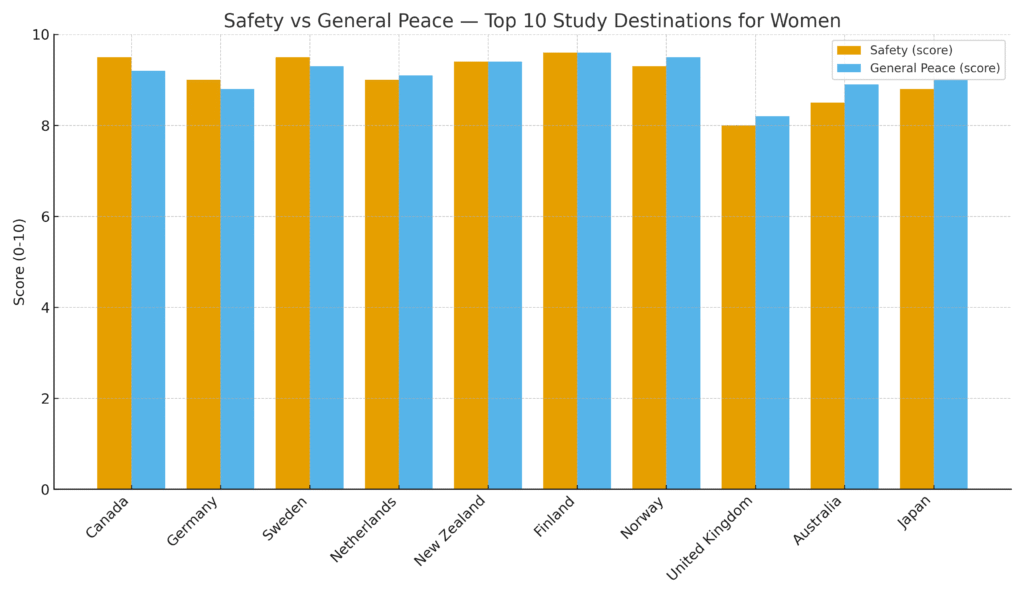
— Illustrates the difference between “overall safety” and “female-specific safety.”
Ranking (Comprehensive Scoring, Listed from Highest to Lowest)
Explanation: The following Top10 is a comprehensive recommendation based on the above methodology.
Canada — Comprehensive Score: ≈ 91/100.
Reasons: High sense of safety, strong gender inclusivity, top-tier institutions with numerous scholarships, friendly post-graduation work and immigration pathways. Sources and evidence: WPS/Global Peace and QS/education statistics.
Germany — Comprehensive Score: ≈ 88/100.
Reasons: High education quality (especially in engineering/STEM/medicine), low or no tuition at public universities, well-developed social support and female legal protection (though nighttime safety varies by city).
Sweden — Comprehensive Score: ≈ 86/100.
Reasons: High rankings in Nordic gender equality and social safety, many English-taught programs, robust university support systems.
Netherlands — Comprehensive Score: ≈ 84/100.
Reasons: Numerous English-taught master’s and PhD programs, good international student services, female-friendly policies, and high quality of life.
New Zealand — Comprehensive Score: ≈ 83/100.
Reasons: High social safety, clear government policies for international student protection, friendly campus environment.
Finland — Comprehensive Score: ≈ 82/100.
Reasons: Extremely high safety and gender equality indicators, outstanding education quality, but some courses have language barriers.
Norway — Comprehensive Score: ≈ 80/100.
Reasons: Nordic welfare and safety culture, high education quality but relatively high cost of living.
United Kingdom — Comprehensive Score: ≈ 78/100.
Reasons: Concentration of world-top universities, advantage of short study duration (1-year master’s), but safety/cost of living differences across cities.
Australia — Comprehensive Score: ≈ 77/100.
Reasons: Strong education quality and career connection (post-study work), friendly to international female students, but high cost of living and nighttime safety concerns in some cities need attention.
Japan — Comprehensive Score: ≈ 75/100.
Reasons: Steady education and research strength, generally good campus safety, but language and cultural adaptation are barriers for non-Japanese speakers; support policies for female students have been gradually strengthened in recent years.
Note: Nordic countries (Iceland, Denmark) score very high on “female safety/gender equality” indicators, but due to smaller international student scale and lower proportion of English-taught programs (especially undergraduate), their comprehensive ranking is slightly behind countries that balance “educational attractiveness and language availability.” Readers can choose based on their own preferences (safety first / English-taught first / low tuition first) from this list.
In-Depth Analysis per Country
1) Canada

Safety / Gender Equality: Women generally feel safe; WPS and multiple peace indices show Canada scores excellently in female inclusivity and public safety.
Education Quality / Programs: Multiple universities (Toronto, UBC, McGill, etc.) rank high globally; wide coverage of English-taught programs.
Cost and Scholarships: Tuition is moderately high, but there are many scholarship and grant opportunities; cost of living varies by city (Montreal is relatively lower than Toronto/Vancouver).
Graduation & Employment: Post-Graduation Work Permit (PGWP) allows graduates to work in Canada and accumulate qualifications for permanent residence; very friendly for female students who wish to immigrate (details can be checked with IRCC).
2) Germany

Safety / Gender Equality: Mature legal protection and social support system; female support services are commonly available on campus.
Education Quality / Programs: Strong advantages in science, engineering, and medicine; many public universities charge low or no tuition for international students (varies by state).
Cost and Scholarships: Low or no tuition, but cost of living (especially in Berlin/Munich) requires planning; DAAD offers various scholarships for women/researchers.
Graduation & Employment: Can apply for an 18-month job-seeking visa after graduation; Germany’s manufacturing and research institutions offer many opportunities, suitable for long-term development for female STEM students.
3) Sweden

Safety / Gender Equality: A Nordic model, leading in gender equality and social welfare policies.
Education Quality / Programs: Abundant English-taught master’s programs; mature internationalization services.
Cost and Scholarships: More friendly to EU students; non-EU students pay tuition but scholarship options exist.
Graduation & Employment: Offers a job-seeking visa; opportunities in IT, life sciences, and sustainability fields.
4) Netherlands
Safety / Gender Equality: Socially inclusive, with robust legal protection for women.
Education Quality / Programs: English-taught programs are among the best in Europe (many business schools and engineering majors).
Cost and Scholarships: Moderate tuition; can apply for Dutch government and university scholarships.
Graduation & Employment: Can apply for a one-year Orientation Year visa after graduation; startups and tech companies particularly welcome international female talent.
5) New Zealand
Safety / Gender Equality: Strong community atmosphere in a small country; high safety and social trust indices.
Education Quality / Programs: Education system balances practice and research; some majors are internationally recognized.
Cost and Scholarships: Relatively moderate tuition and living costs; schools and the government offer several scholarships.
Graduation & Employment: Post-study work visas and immigration pathways are friendly to high-skilled graduates.
6) Finland
Safety / Gender Equality: Extremely high gender equality and social safety.
Education Quality / Programs: Known for education research, information technology, and design programs.
Cost and Scholarships: Tuition generally exists for non-EU students, but scholarships and research funding can cover part of the cost.
Graduation & Employment: Technical graduates are competitive in the Nordic job market.
7) Norway
Safety / Gender Equality: Leading in social welfare and gender policies; women feel safer traveling at night.
Education Quality / Programs: High-quality bachelor’s/master’s programs; the number of English-taught programs is increasing yearly.
Cost and Scholarships: Most public universities have no tuition (exceptions for international students), but the cost of living is high.
Graduation & Employment: Opportunities in energy, marine engineering, and sustainable technology.
8) United Kingdom
Safety / Gender Equality: Varies by city (London, Manchester, etc., offer different experiences); universities have dedicated female support centers.
Education Quality / Programs: Concentration of world-top universities (Oxford, Cambridge, LSE, etc.); intensive courses with global recognition.
Cost and Scholarships: High tuition and living costs, but scholarships (e.g., Chevening) are open to outstanding female postgraduate students.
Graduation & Employment: Graduate Route provides 2 years (master’s) or 3 years (PhD/research) of work opportunities in the UK after graduation.
9) Australia
Safety / Gender Equality: Generally safe, good campus support, but some cities have nighttime safety concerns.
Education Quality / Programs: The Group of Eight and top research universities attract many female postgraduate students.
Cost and Scholarships: High tuition, but research scholarships and grants can alleviate the pressure.
Graduation & Employment: Post-Study Work visa policy is friendly to international students.
10) Japan
Safety / Gender Equality: Generally high public safety, but gender culture adaptation takes time (language and social norms).
Education Quality / Programs: Strong in engineering, materials, and robotics research; English-taught programs are gradually increasing.
Cost and Scholarships: Some national universities have low tuition; the Japanese government and private institutions offer various scholarships.
Graduation & Employment: The job market is competitive, but opportunities in engineering, AI, and life sciences are growing.
Trend Observations (Particularly Important for Female International Students)
Nordic countries continue to lead in “safety + gender equality,” but language and the language of instruction remain factors to consider when choosing. The expansion of English-taught programs (especially in the Netherlands, Nordic countries, and Japan) is lowering language barriers, providing more options for female students.
Post-graduation work and immigration pathways are becoming key decision factors: Canada, Australia, and the UK have introduced clearer post-study work policies in recent years, attracting many female students. Campus gender violence prevention and psychological support are receiving more attention: universities are gradually increasing transparency in policies and resources; female students should focus on the university’s “gender violence response system” and “mental health services” when selecting schools.
For Female Students Preparing to Study Abroad — Practical Checklist (Before Departure and While Abroad)
Before Departure:
Verify the destination country’s WPS / Global Peace Index data and the university’s student safety reports; understand local emergency contact numbers and the contact information for the Chinese/your country’s embassy or consulate in the area.
Visa and Insurance:
Be sure to purchase international medical insurance that includes coverage for gender-based violence/medical evacuation; verify the school’s legal support services for international students.
After Enrollment:
Join on-campus female student clubs and international student support groups; familiarize yourself with the campus reporting process and psychological support services.
Socializing and Nighttime Travel:
Try to use school-certified nighttime escort/shuttle services; learn the rules for using public transportation at night.
Data Sources
UNESCO — Global Education Monitoring Report, “2024 Gender Report” unesco.org
WPS Index(Georgetown Institute)— giwps.georgetown.edu
OECD — Education at a Glance 2024 OECD
QS / Times Higher / Educations.com — qschina.cn
MastersPortal / IDP / Vedantu / Studies-Overseas mastersportal.com