
Top 10 Countries with Highest Prison Population
Contents
Introduction
Prison population is a complex reflection of a country’s judicial system, public security policies, and human rights concepts. A higher number of incarcerated individuals in a country allows us to see the deterrent effect of the law, but also highlights potential systemic pressures and social structural issues. Based on multi-source data, this article compiles a list of the top ten countries with the largest incarcerated populations globally, and attempts a balanced analysis of the underlying reasons, as well as the future challenges and directions for reform these countries face.
Data Explanation
Primary Data Source
This article primarily uses national incarceration data from the Prison Policy Initiative’s “States of Incarceration” report as the main measurement basis.
Definition of “Prison Population”
Refers to individuals currently formally incarcerated (excluding some instances of pre-trial detention, etc.).
Ranking Basis
The ranking is based on a cross-comparison of the latest publicly available data (2025 or the most recent year’s reports).
Additional Metric
Considering differences in national populations, we also note both the absolute number of prisoners and the incarceration rate (per 100,000 people).
Ranking — Top 10 Countries by Prison Population (Estimates)
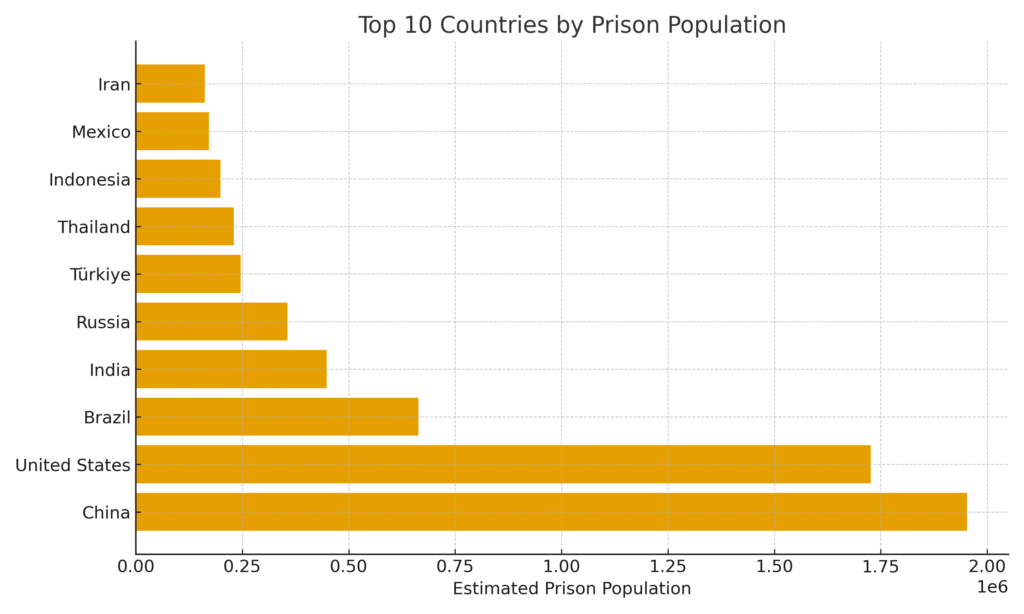
The following list details the top ten countries based on available data (Prison Population):
| Rank | Country | Estimated Prison Population |
|---|---|---|
| 1 | China | ~1,952,658 |
| 2 | United States | ~1,726,496 |
| 3 | Brazil | ~664,204 |
| 4 | India | ~448,400 |
| 5 | Russia | ~356,201 |
| 6 | Türkiye | ~245,864 |
| 7 | Thailand | ~230,337 |
| 8 | Indonesia | ~198,793 |
| 9 | Mexico | ~171,890 |
| 10 | Iran | ~161,924 |
Country Profiles
1. China
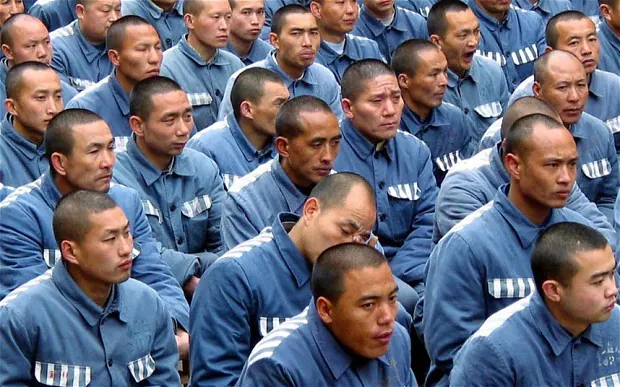
System Characteristics: Vast prison population, complex judicial system with various types of detention facilities.
Social Impact: High incarceration numbers reflect strict laws and systemic public security strategies.
Key Issues: Transparency and rights safeguards draw international attention; pretrial and repatriation systems require improvement.
2. United States
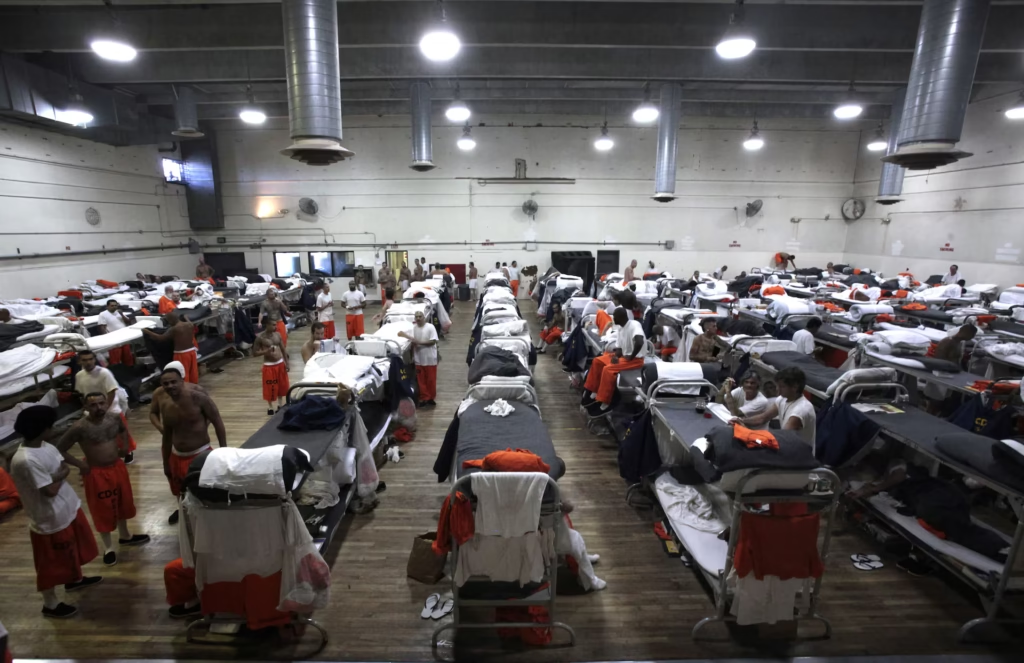
System Characteristics: Extremely high incarceration rate, strict sentencing, coupled with civil penalties and habitual offender laws often criticized.
Social Impact: Mass incarceration has profound effects on community disruption and family structures.
Key Issues: Racial disparities, high recidivism rates, enormous prison expenditures.
3. Brazil

System Characteristics: Severely overcrowded prison system, many inmates are in pre-trial detention.
Social Impact: High correlation between poverty and crime; incarceration serves as a tool for social control.
Key Issues: Inadequate facilities, extreme overcrowding, poor prison hygiene and safety conditions.
4. India
System Characteristics: Slow judicial process, lengthy pre-trial detention periods.
Social Impact: Large numbers of detainees remain in prolonged pre-trial status, placing a heavy burden on individuals and families.
Key Issues: Lagging judicial reforms, overcrowded prisons, uneven resource distribution.
5. Russia
System Characteristics: Vast penal system, high baseline prison population.
Social Impact: Criminal law and incarceration are still used as tools for social governance in some regions.
Key Issues: Recidivism rates, prison conditions, pressure for penal policy reform.
6. Türkiye
System Characteristics: Political factors significantly influence certain incarceration cases.
Social Impact: Some imprisonments are perceived as political punishment, impacting civil rights.
Key Issues: Human rights organizations raise concerns about detention transparency and judicial independence.
7. Thailand
System Characteristics: Large number of prisons, aging infrastructure.
Social Impact: Prison overcrowding affects inmate rehabilitation and reintegration into society.
Key Issues: Health concerns, severe overcrowding, and ineffective resolution of long-term detention issues.
8. Indonesia
System Characteristics: Incarceration widely used for minor offenses and drug-related cases.
Social Impact: Significant strain on the prison system, posing long-term challenges to economic and social resources.
Key Issues: Lack of rehabilitation resources, need to strengthen the judicial and detention systems.
9. Mexico
System Characteristics: Uneven distribution of resources between prisons and the judicial system, high involvement of local governments.
Social Impact: Complex issues of crime and corruption; incarceration is one aspect of social control.
Key Issues: Prison safety, overcrowding, judicial injustice.
10. Iran
System Characteristics: Judicial system sensitive to political and religious factors; imprisonment of political prisoners is reported.
Social Impact: The prison system places significant social pressure on dissidents and minority groups.
Key Issues: Human rights concerns, low transparency, significant international scrutiny.
Future Trends & Considerations
Prison Reform Wave
Many countries are promoting reductions in prison populations, introducing probation and community correction mechanisms.
Technological Improvements
Electronic monitoring (e.g., ankle bracelets), digital management show potential to alleviate prison pressures.
International Human Rights Pressure
International organizations and civil society continuously call for more transparent and humane incarceration systems.
Recidivism and Social Reintegration
Helping former inmates reintegrate into society and reducing recidivism is key to lowering prison populations in the future.
Q&A (Frequently Asked Questions)
Q1: Does the largest prison population mean the highest incarceration rate?
A1: Not necessarily. Populous countries may have high total incarceration numbers, but their incarceration rate (per 100,000 people) may not necessarily lead globally.
Q2: Why do prison populations continue to grow in some countries?
A2: Reasons include strict judicial policies and heavy sentencing in some cases; also lengthy pre-trial periods and underdeveloped alternative sentencing mechanisms.
Q3: What are the risks of severe prison overcrowding?
A3: Overcrowding can lead to poor sanitation, high violence, insufficient rehabilitation resources, and negatively impact inmate mental health and their ability to reintegrate into society.
Q4: Are there ways to reduce incarceration?
A4: Yes. Through probation, non-custodial punishments, community corrections, digital monitoring, and judicial reform, prison populations can be significantly reduced.
Conclusion

The prison system is a mirror of society, reflecting public security, justice, resource distribution, and human rights. Among the countries with the largest prison populations are both wealthy major powers and middle/low-income nations. Their common challenge is balancing public safety with humanity. Future reform cannot rely solely on reducing numbers; it requires systemic change, making incarceration a “last resort” rather than the “default option.”
Data Sources
Prison Policy Initiative — States of Incarceration: The Global Context 2024 prisonpolicy.org
Visual Capitalist — Ranked: The World’s Biggest Prison Populations Visualcapitalist
World Prison Population List (Poder360 summary) static.poder360.com.br
Grokipedia — List of countries by incarceration rate Grokipedia