
Top 10 Countries with Longest Coastline
Contents
Introduction
The coastline is the gentle interface between land and sea. It witnesses the ebb and flow of tides, the gentle lapping of waves, and reflects a nation’s cultural, economic, and ecological destiny. The longer a country’s coastline, the deeper its connection to the ocean: fisheries, shipping, tourism, and environmental governance are all profoundly influenced. This article compiles authoritative data to present the top 10 countries with the longest coastlines, analyzing their unique relationship with the sea: how the coast has shaped them, and how they utilize and protect it.
Ranking
(Units are in kilometers; data compiled from multiple sources)
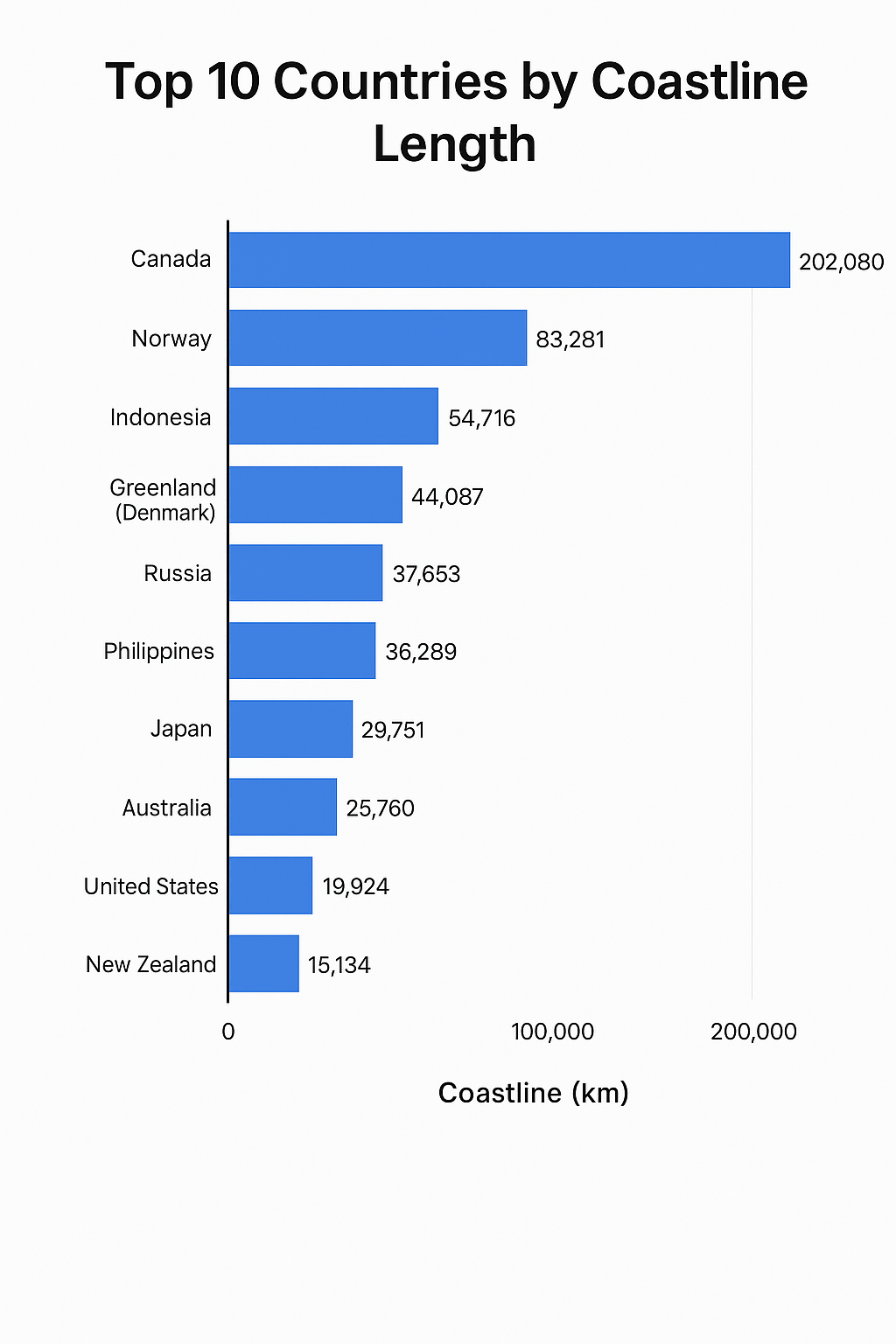
| Rank | Country | Coastline Length (km) |
|---|---|---|
| 1 | Canada | 202,080 km |
| 2 | Norway | 83,281 km |
| 3 | Indonesia | 54,716 km |
| 4 | Greenland (Denmark) | 44,087 km |
| 5 | Russia | 37,653 km |
| 6 | Philippines | 36,289 km |
| 7 | Japan | 29,751 km |
| 8 | Australia | 25,760 km |
| 9 | United States | 19,924 km |
| 10 | New Zealand | 15,134 km |
Data Explanation
Primary Data Sources
CIA World Factbook, World Bank, NOAA, and publicly available data from various national natural resource ministries. Sources were cross-referenced to minimize errors arising from different measurement methodologies.
Regarding Measurement Differences
Coastline length is highly dependent on the scale of measurement (the “coastline paradox“): the finer the scale, the longer the coastline. This article adopts the standardized national-level statistical calibers published by authoritative institutions and does not involve remeasurement.
Synthesis Rules
No machine learning or recalculation was performed. We employed a “multi-source cross-verification + latest data priority” model: when multiple authoritative sources reported consistent or similar coastline lengths for a country, that value was used as the final figure.
Important Note
The year of data varies slightly between sources (typically within ±1–3 years). For scientific research purposes, please refer to the latest raw data from official agencies.
In-Depth Country Analysis (Geography + Resources + Risks)
Canada
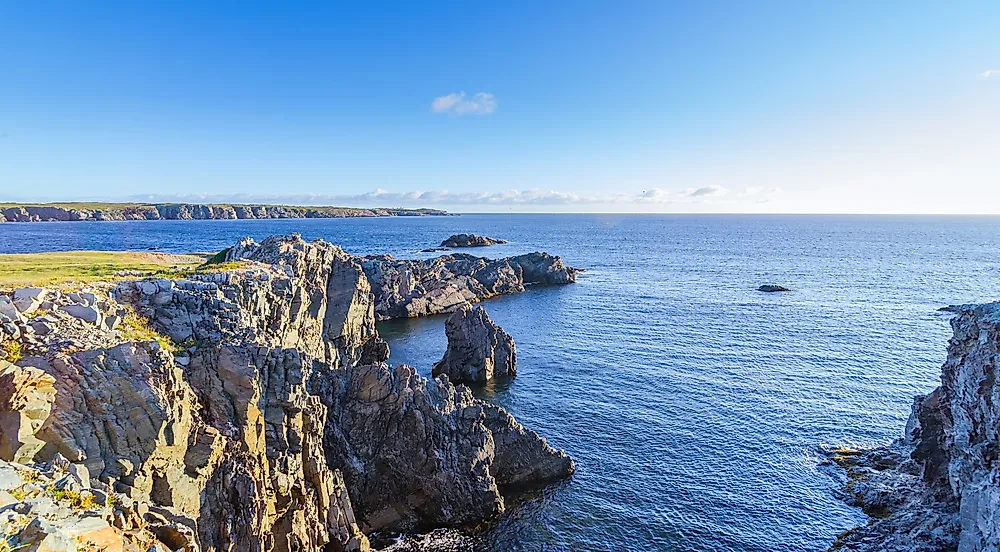
Geography & Coastal Features: Possesses an extremely complex coastline, encompassing countless small islands, bays, and fjords.
Resources & Livelihood: Significant potential in fisheries, shipping, and the Arctic shipping route.
Challenges: Ice melt in the Arctic region, coastal erosion, environmental protection, and infrastructure maintenance.
Norway
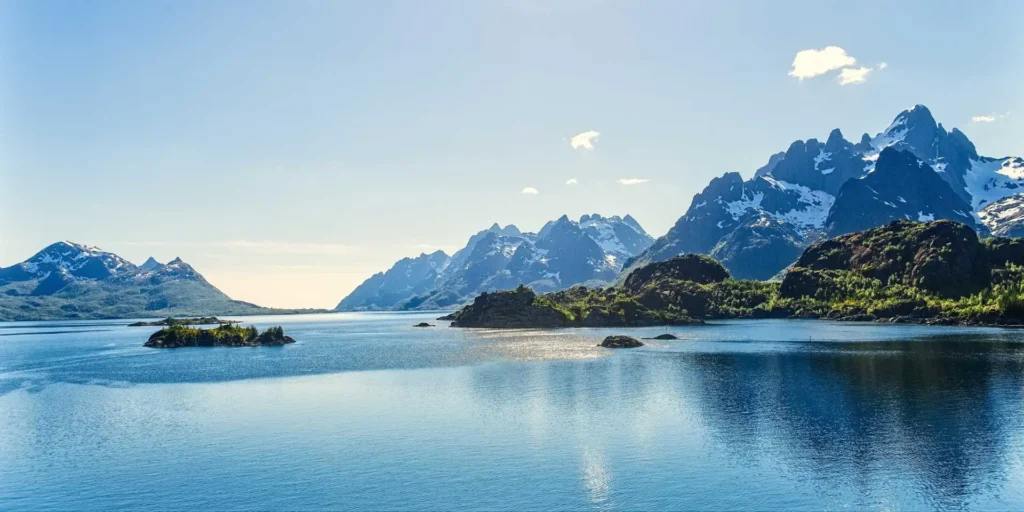
Geography: Dense concentration of fjords and numerous small islands result in a highly indented coastline.
Resources: Fisheries, offshore oil, offshore wind power.
Challenges: Sea-level changes, coastal erosion, protection of ecologically sensitive areas.
Indonesia
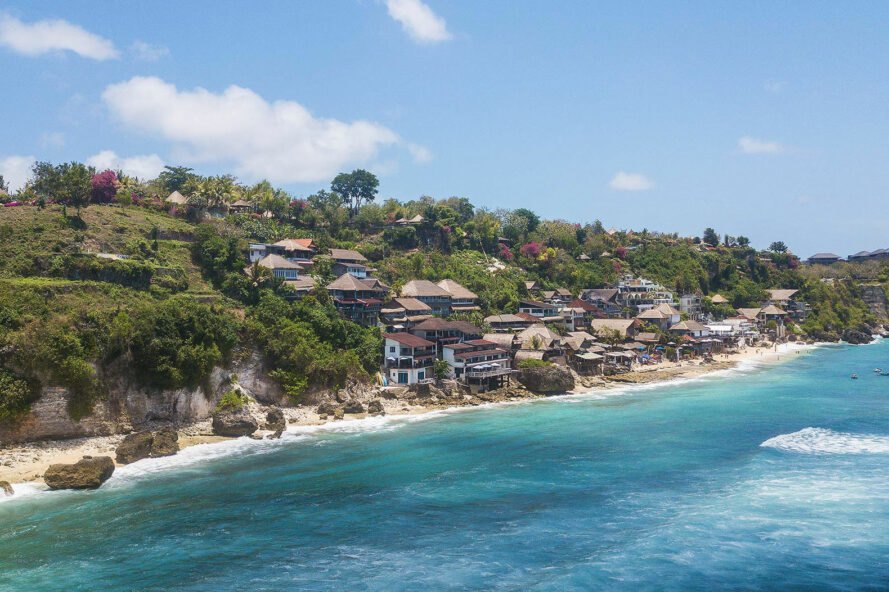
Geography: An archipelagic structure, with thousands of islands connected by the sea.
Resources: Fisheries, tourism, rich marine biodiversity.
Risks: Sea-level rise, land subsidence on islands, marine debris, coral reef destruction.
Greenland (Denmark)
Geography: A polar coastline dominated by vast glaciers and fjords.
Resources: Glacial meltwater, mineral potential.
Challenges: Climate warming causing ice sheet retreat, leading to constant reshaping of the coastline.
Russia
Geography: Extensive coastlines bordering three oceans (Arctic, Pacific, Atlantic).
Resources: Shipping, major ports, exploitation of natural resources.
Challenges: High risks associated with Arctic opening, impacts of climate warming, marine resource management.
Philippines
Geography: Composed of thousands of islands, resulting in a complex and extensive coastline.
Resources: Abundant fishery resources, developed island tourism.
Risks: Frequent typhoons, coastal erosion, sea-level rise, marine pollution.
Japan
Geography: A typical island nation, surrounded by sea on all sides.
Resources: Fisheries, port economy, marine technology.
Risks: Earthquake and tsunami risks, significant pressure on coastal protection and urban disaster prevention.
Australia
Geography: A continental nation with vast coastlines and diverse ecosystems.
Resources: Coral reefs (e.g., Great Barrier Reef), tourism, and port economy.
Risks: Coral bleaching, seawater warming, coastal erosion, extreme weather events.
United States
Geography: Possesses diverse coastlines, from Alaska to Florida to Hawaii.
Resources: Commercial shipping, major ports, maritime infrastructure.
Challenges: Sea-level rise, flood prevention pressure on coastal cities and infrastructure, maintaining ecological balance.
New Zealand
Geography: Composed of two main islands with scenic coastlines.
Resources: Tourism, marine life, natural reserves.
Risks: Coastal erosion, ecological fragility of small islands, climate change impacts on coastal communities.
Global Trends: The Future of Coastlines Will Be Rewritten
Over the next 50 years, coastlines will undergo more dramatic changes than in the past several millennia:
1. Sea-Level Rise Redefining National Outlines
Millions of people live in coastal cities; the first impacts will be on ports and low-lying areas.
2. Coastal Ecosystems Shifting from Rich to Fragile
Coral bleaching, fisheries decline, and ocean acidification are weakening the economic resilience of coastal nations.
3. The Rise of the “Blue Economy“
Marine renewable energy and ocean carbon sequestration technologies are becoming strategic priorities for many countries.
4. Arctic Shipping Routes Changing Global Trade
The long coastlines of Canada and Russia will become new key players in global shipping.
Q&A
Q1: Why aren’t the countries with the longest coastlines necessarily island nations?
A1: Because “coastline length” depends not only on whether the landmass is an island but also on the complexity of the coastline. Mainland countries like Canada, with thousands of islands and highly indented coastlines, can have very large measured lengths.
Q2: What is the relationship between coastline length and national power/economy?
A2: Countries with long coastlines typically have more marine resources (fisheries, oil/gas, shipping) and tourism opportunities. However, it also means they must face more complex coastal governance, sea-level rise, and natural disaster risks.
Q3: Could sea-level rise “change the ranking”?
A3: It is possible. As global warming causes ice sheet melt and sea-level rise, some coastlines may retreat or be redefined. This change could be particularly significant for countries with very indented coastlines or numerous islands.
Q4: How is this coastline data measured?
A4: Coastline length is calculated through satellite mapping, Geographic Information System (GIS) analysis, and comprehensive geodetic survey tools. Different institutions and datasets may use different measurement criteria (e.g., whether to include small bays and capes on islands), leading to variations in the numbers.
Q5: Why do different sources have discrepancies in coastline length rankings?
A5: Due to different measurement standards. Some sources include all small islands, bays, and capes, while others only measure the main coastline. Additionally, differences in data measurement precision, satellite resolution, and the time of measurement can also lead to errors.
Conclusion: Why Do Longer Coastlines Make a Country Seem More Gentle?
Because nations with long coastlines engage in a daily dialogue with the ocean. Whether it’s the Arctic wind, tropical corals, or the lights of city ports, the coast brings not just resources, but the most direct connection between humanity and nature. The longer the coastline, the more a country can hear the voice of the sea. And the more we understand these coasts, the better we understand the future of this planet.
Data Sources
WorldAtlas – “Countries With The Most Coastline” WorldAtlas
Top10Lists.net – “Top 10 Longest Coastlines” Top10Lists.net
Jagran Josh – “Top 10 Countries by Length of Coastline (CIA)” Jagranjosh.com
CurrentAffairs.Adda247 – “Longest Coastline in the World 2024” adda247
MapsofWorld – “World Top Ten Longest Coastline Countries” Maps of World