
Top 10 Countries with the Longest Life Expectancy
Contents
Introduction
Everyone seeks longevity, but places that truly achieve long life spans are never accidental. Globally, some countries and regions, leveraging advanced healthcare, high-quality lifestyles, stable institutions, and social support, nurture generation after generation of elderly populations. Longevity is not just a number; it is a comprehensive reflection of a nation’s respect for life, the strength of its healthcare system, social equity, and the natural environment. This article compiles a list of the top ten countries/regions with the highest life expectancy, using narrative combined with rigorous data to reveal the drivers and lessons behind their longevity.
Data Explanation
This ranking is primarily based on multiple public and authoritative data sources (see “Data Sources” below), combined with the most recent available life expectancy estimates. The metric used is “Life Expectancy at Birth“, which is the average number of years a newborn is expected to live if current mortality patterns remain constant.
Data Integration Method
Data from multiple sources (e.g., Adda247, WorldOStats, DataPandas) were cross-referenced, taking averages or consistently high values to avoid bias from any single source.
Important Note
Calculation methods may vary slightly between sources (e.g., year of data, gender weighting, regional classification). The values here are internationally accepted estimates but may not equal gender-specific or provincial data from some national statistical bureaus.
Ranking — Top 10 Countries / Regions by Life Expectancy
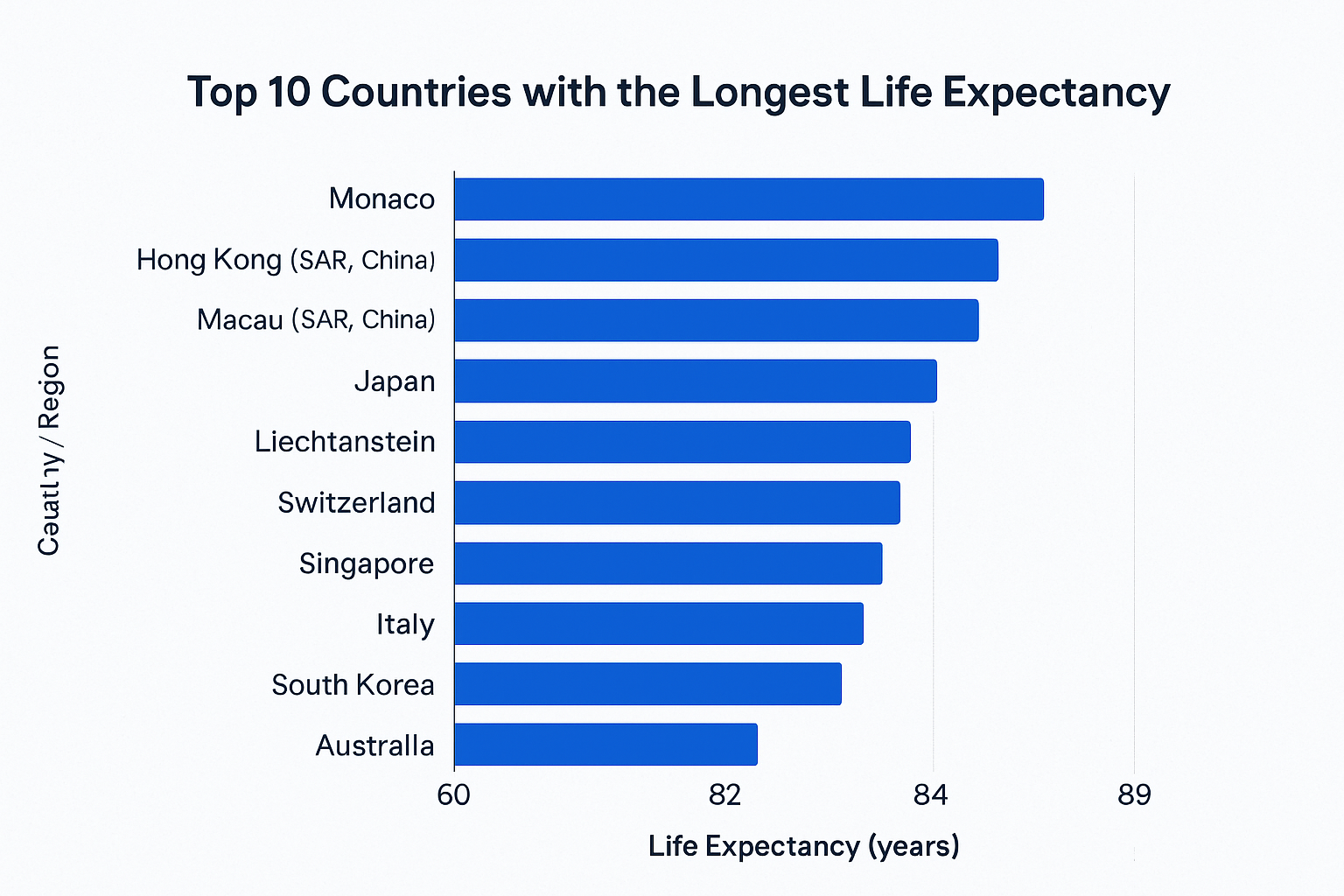
| Rank | Country / Region | Life Expectancy (years) |
|---|---|---|
| 1 | Monaco | ~87.0 |
| 2 | Hong Kong (SAR, China) | ~85.8 |
| 3 | Macau (SAR, China) | ~85.5 |
| 4 | Japan | ~84.95 |
| 5 | Liechtenstein | ~84.8 |
| 6 | Switzerland | ~84.38 |
| 7 | Singapore | ~84.27 |
| 8 | Italy | ~84.20 |
| 9 | South Korea | ~84.14 |
| 10 | Australia | ~83.73 |
In-Depth Country/Region Analysis: Why Do They “Live Longer”?
Monaco

Institutions & Resources: Small but wealthy, with a high-quality healthcare and social security system.
Lifestyle: Pleasant Mediterranean climate, low crime rate, high health consciousness.
Challenges: High population density, significant aging population risks; relatively high dependence on external medical resources.
Hong Kong (SAR, China)
Institutions: Efficient public health system, concentrated medical resources.
Culture: Traditional diet (seafood, low oil), tight-knit community social networks.
Risks: Pressure from an aging population, high housing costs affecting quality of life.
Macau (SAR, China)

Institutions: Public healthcare + high tourism revenue, relatively ample resources.
Lifestyle: High income, relative social stability, emphasis on quality of life.
Challenges: Coexistence with an aging population, pressure for sustainable elderly care.
Japan

Culture & Diet: Diet rich in fish, vegetables, fermented foods; frequent traditional physical activities.
Social Networks: High participation of the elderly in community groups and activities, fostering a strong sense of social belonging.
Institutions: Universal health insurance + leading longevity research.
Challenges: Super-aged society, shrinking workforce, pressure on pension funds.
Liechtenstein
Social Institutions: High welfare, efficient governance in a small state.
Lifestyle: Beautiful environment, high safety index, comfortable living conditions.
Challenges: Small but aging population; susceptible to external economic fluctuations.
Switzerland
Healthcare Quality: World-class medical technology and services.
Habits: Prevalence of outdoor activities (hiking, mountaineering), high health consciousness.
Challenges: High medical costs; high demand for elderly medical care and nursing home resources.
Singapore
Institutions: Efficient public health system + proactive preventive healthcare policies.
Culture: Modern urban planning, good air quality, fast-paced but well-managed lifestyle.
Risks: High cost of living, tight supply of elderly housing, significant social pressure.
Italy
Diet: Famous Mediterranean diet, with olive oil, vegetables, and fish as longevity secrets.
Society: Strong family ties, rich social networks.
Challenges: Significant North-South disparities, declining youth population, uneven distribution of medical resources.
South Korea
Healthcare System: Developed universal healthcare + high-tech medical facilities.
Diet & Lifestyle: Diet based on fermented foods (kimchi), vegetables; coexistence of traditional and modern lifestyles.
Challenges: High mental stress, rapid aging, soaring demand for long-term care.
Australia
Environment: Relatively clean air, lifestyle oriented towards the outdoors.
Healthcare: Dual system of public and private healthcare.
Challenges: Uneven healthcare coverage in remote areas, significant health disparities for Indigenous populations.
Future Trends
Aging Populations Continue
A common challenge for these long-lived countries is population aging, which will put greater pressure on pension systems, medical resources, and social security.
Technology Boosts Health
Genetic technology, digital health, and telemedicine are becoming important forces in extending healthy lifespans.
The Importance of Social Connection
Longevity is not just about healthcare; it is closely linked to social support, community participation, and mental health.
Policy Shift
A shift from merely extending life to “extending health“: Future policies will focus more on “healthy life expectancy” rather than just total lifespan.
Q&A (Frequently Asked Questions)
Q1: Are life expectancy and actual lifespan the same concept?
A: No. Life expectancy is a statistical average estimate based on current mortality patterns, while an individual’s actual lifespan can be much longer or shorter.
Q2: Why do some small countries/states (e.g., Monaco) have particularly high life expectancy?
A: Small states often have high per capita income, advanced healthcare, and stable data. However, they also face realities like small populations and high medical costs.
Q3: Is life expectancy determined solely by healthcare?
A: Not entirely. It is a statistical estimate determined by current mortality rates across all age groups, but the healthcare system, public health policies, and lifestyle habits profoundly influence it.
Q4: Does high life expectancy in these countries mean others are unhealthy?
A: Not necessarily. Lifespan is influenced by many factors, including genetics, healthcare, environment, and social security. Countries with high life expectancy symbolize health and institutional excellence, but progress in other countries should not be overlooked.
Conclusion

Longevity is a gift from time. In the countries with the longest life expectancy globally, we see a culture of respect for life, and a “stage for longevity” built together by institutions, healthcare, and society. Their experience reminds us that extending life is not just a victory for medicine, but also a reflection of social wisdom. May every country create a longer, healthier, and more dignified journey for every life.
Data Sources
Jagran Josh — Which Country Has the Highest Life Expectancy? Top 10 Countries With the Highest Life Expectancy Jagranjosh.com
Times of India — 10 countries with the highest life expectancy in 2025 The Times of India
DataPandas — Life Expectancy By Country 2025 Data Pandas
WiseVoter — Life Expectancy by Country 2023 Wisevoter
Database.Earth — Life Expectancy by Country 2023 database.earth