
Top 10 Financial Centers in the World
Contents
Introduction
A financial center is not merely a node for capital flows; it is a complex ecosystem interwoven with talent, regulation, technology, and trust. A strong financial center can propel regional economies, support business growth, and attract global talent. However, it also faces challenges such as regulatory balance, housing, and talent mobility. Based on the Z/Yen Global Financial Centres Index (GFCI 37, March 2025) and other authoritative sources, this article presents the current status and trends of the world’s top ten financial centers, combining warm narrative with data interpretation.
Data Explanation
Primary Source
Z/Yen / Long Finance — Global Financial Centres Index (GFCI 37, March 2025); supplemented and cross-verified with Reuters, IFC Review, and industry reports.
Indicator Meaning
The GFCI scores global financial centers based on “comprehensive competitiveness,” covering multiple dimensions such as business environment, financial sector development, human capital, infrastructure, and reputation. The score is a composite index (rating).
Definition and Timeframe
This article uses the scores and rankings published in GFCI 37 (March 2025). Differences in order may occur if using other years or different evaluation systems (e.g., financial center influence index, FinTech rankings).
Note
GFCI data comes from questionnaire assessments (expert opinion) and public data, reflecting the relative competitiveness of financial centers well, but it is not an absolute quantification of all financial-related indicators.
Quick Ranking
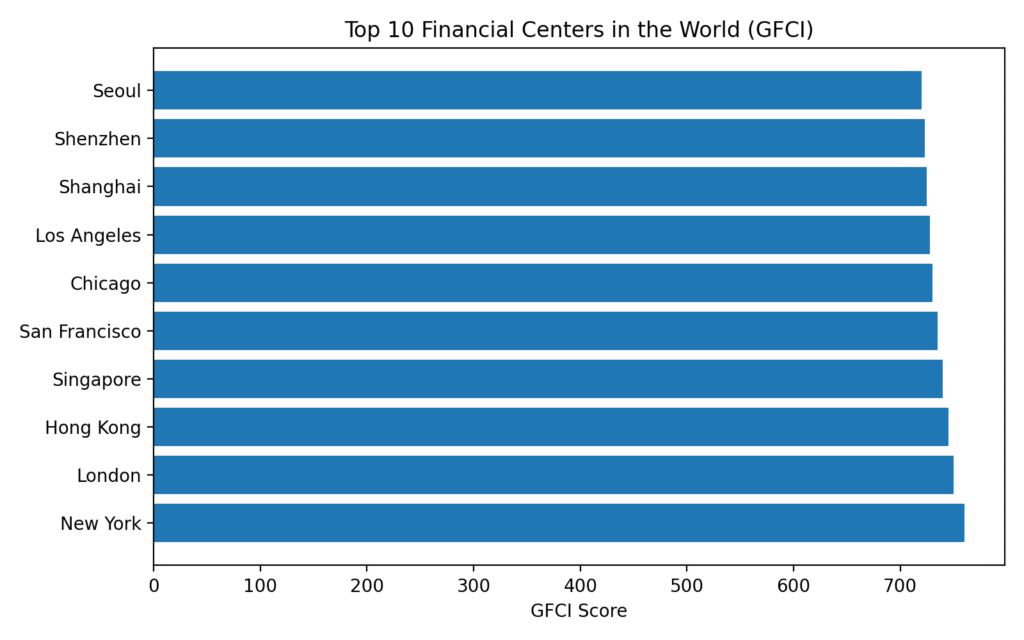
| Rank | City (Country) | GFCI Rating |
|---|---|---|
| 1 | New York (USA) | 769 |
| 2 | London (UK) | 762 |
| 3 | Hong Kong (China) | 760 |
| 4 | Singapore | 750 |
| 5 | San Francisco (USA) | 749 |
| 6 | Chicago (USA) | 746 |
| 7 | Los Angeles (USA) | 745 |
| 8 | Shanghai (China) | 744 |
| 9 | Shenzhen (China) | 743 |
| 10 | Seoul (South Korea) | 742 |
City Snapshots
1. New York, USA
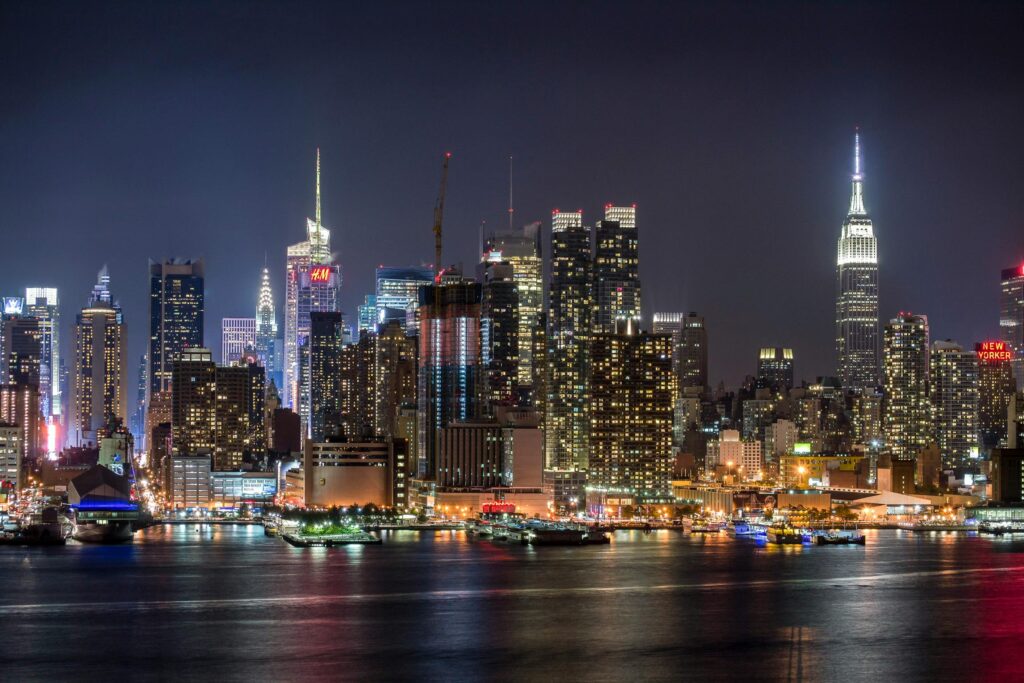
Core Strengths: World’s largest financial market: numerous major investment banks, hedge funds, exchanges (NYSE, NASDAQ), and a broad capital market ecosystem.
Main Functions: Capital formation, securities trading, asset management, and global financial innovation (especially in alternative assets and private equity).
Challenges: High regulatory compliance costs, rising office space and cost of living, intense competition for talent.
2. London, UK
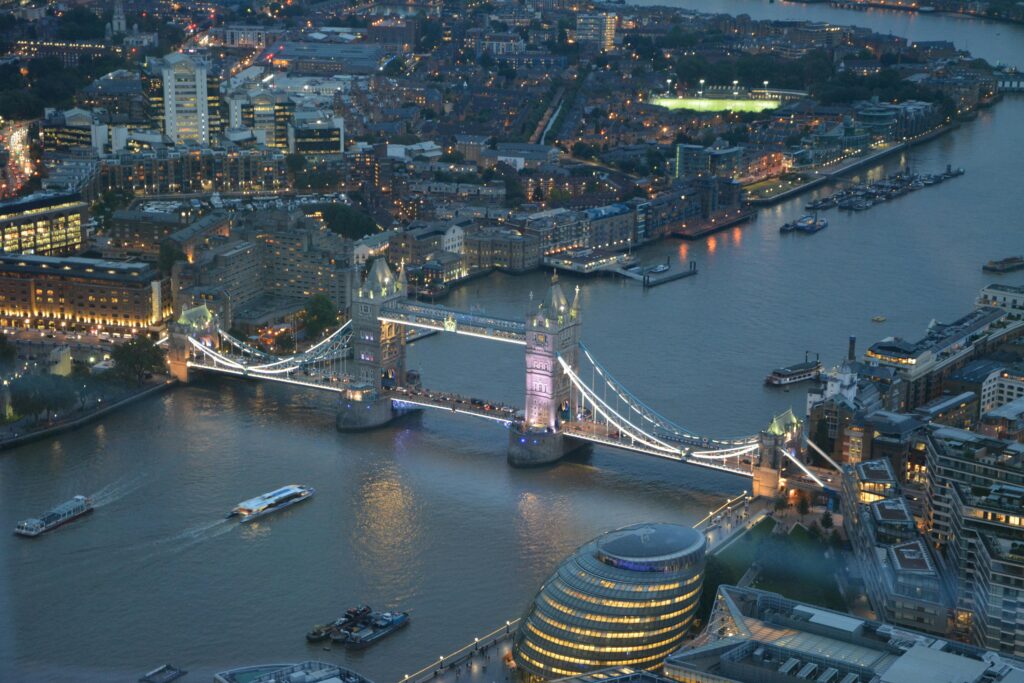
Core Strengths: Europe’s financial and insurance hub, with mature legal and financial infrastructure; its timezone makes it a transatlantic trading nexus.
Main Functions: Foreign exchange trading, insurance, global banking headquarters, and international capital markets.
Challenges: Institutional adjustments post-Brexit, cross-border financial service frictions, and talent mobility issues.
3. Hong Kong, China
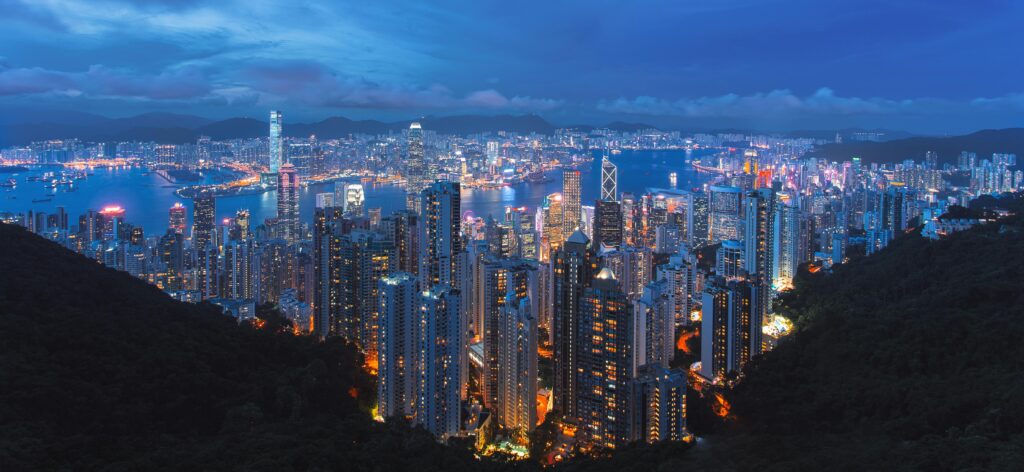
Core Strengths: A bridge between China and international markets, with an open capital market, active IPOs, and a significant role as a platform for RMB internationalization.
Main Functions: Equity financing, IPOs, wealth management, and cross-border RMB business.
Challenges: Geopolitical and regulatory coordination, division of labor, and competition with the mainland market.
4. Singapore
Core Strengths: Stable regulatory environment, mature wealth management and family office ecosystem, FinTech innovation-friendly.
Main Functions: Wealth management, trade finance, green finance, and regional financial services.
Challenges: Scale limitations and rising talent costs, requiring continuous innovation to maintain competitiveness.
5. San Francisco, USA
Core Strengths: Concentration of venture capital and tech companies, deep integration of technology and finance (FinTech, crypto innovation).
Main Functions: Venture capital, tech-finance innovation, and the pre-IPO corporate ecosystem.
Challenges: High housing costs, talent distribution, and regulatory uncertainty (especially in crypto and data regulation).
6. Chicago, USA
Core Strengths: Long history in derivatives and futures markets (CME Group), strong financial market infrastructure.
Main Functions: Derivatives trading, commodity and risk management services, financial infrastructure.
Challenges: Needs to continuously enhance its appeal to talent and emerging FinTech compared to global first-tier cities.
7. Los Angeles, USA
Core Strengths: Blends entertainment, technology, and innovative capital, with active private equity and venture capital activity.
Main Functions: Private equity, venture capital, entertainment finance, and cross-sector investment and financing.
Challenges: Urban governance and infrastructure adapting to rapid growth demands.
8. Shanghai, China
Core Strengths: One of China’s financial centers, with rapidly expanding capital market scale and steady opening-up steps.
Main Functions: Stock trading, bond markets, financial technology, and cross-border RMB business.
Challenges: Institutional frictions in market connectivity with the international sphere; financial opening details need continuous refinement.
9. Shenzhen, China
Core Strengths: Dense concentration of tech firms, high integration of financial innovation and technology (especially in tech-finance and brokerage services).
Main Functions: Tech-ecosystem-enabled financial services, venture capital, and a testing ground for FinTech.
Challenges: Market maturity and internationalization need improvement; capital market international recognition needs enhancement.
10. Seoul, South Korea
Core Strengths: An emerging FinTech powerhouse in Asia, with steadily developing banking and capital markets.
Main Functions: Regional investment and financing, FinTech, securities, and banking services.
Challenges: Aging population and talent competition; the pace of financial service internationalization needs acceleration.
Frequently Asked Questions (Q&A)
Q1: What kind of city qualifies as a “world-class financial center”?
A1: A world-class financial center typically possesses highly developed financial markets, a sound legal and regulatory system, ample international capital flows, dense concentrations of financial institutions and high-end talent, and plays a key hub role in the global or regional financial system. The GFCI is precisely evaluated based on these comprehensive dimensions.
Q2: Why have New York and London consistently held the top two positions?
A2: New York has the world’s deepest capital markets and trading volume, while London complements it with its mature legal environment, forex and insurance advantages, and cross-timezone location. Both are difficult to surpass comprehensively in the short term regarding financial infrastructure, international trust, and talent attractiveness. h3>Q3: Why are Asian financial centers occupying increasingly important positions in the top ten?
A3: Asian economies have stable growth, rapid wealth accumulation, and strong regional capital demand. Hong Kong, Singapore, Shanghai, Shenzhen, and Seoul are gradually narrowing the gap with traditional Western financial centers through institutional openness, FinTech, and regional hub positioning.
Q4: Is the GFCI ranking equivalent to the absolute level of “financial strength”?
A4: Not entirely. The GFCI emphasizes comprehensive competitiveness and international appeal more than a single indicator (like GDP or total financial assets). Different ranking systems may yield varying results due to different weightings, but the overall trend has high reference value.
Q5: Will FinTech change the landscape of future financial centers?
A5: It will reshape the landscape to some extent. FinTech lowers the geographical barriers to financial services, allowing some cities to rise rapidly in niche areas. However, in the foreseeable future, the world’s top financial centers will maintain their advantages, though their internal structures and functional divisions will change.
Future Trends (Next 3–5 Years)
Increased Emphasis on “Sustainable Finance” and Climate Issues
Green bonds, climate risk assessment, and sustainable financial services will become important components of a center’s competitiveness.
FinTech-Driven Specialization and Rise of Emerging Centers
Deep integration of technology and capital (as in San Francisco and Shenzhen) will drive the development of specialized financial services. Some mid-sized cities may rise due to professional advantages.
Geopolitics Remains a Key Variable
Regulatory coordination, cross-border capital flows, and financial opening policies will directly impact a financial center’s appeal.
The Balancing Act Between Talent Competition and Cost of Living
Financial centers will need to find a balance between taxation, housing, and public services to retain high-level talent.
Conclusion
The competition among financial centers is a race of systems, markets, and talent. New York’s deep markets, London’s timezone and legal advantages, the regional hub roles of Hong Kong and Singapore, and the tech-finance fusion of San Francisco and Shenzhen all tell us that a strong financial center requires both the power of capital and the warmth of sound institutions. The future winners will be the cities that can find the optimal balance between innovation and regulation, openness and stability.
Data Sources
Z/Yen Partners & Long Finance — Global Financial Centres Index (GFCI 37, March 2025). https://www.longfinance.net/programmes/financial-centre-futures/global-financial-centres-index/ Long Finance+1
Reuters — New York keeps top spot, London second in Z/Yen financial centre survey (March 2024). https://www.reuters.com/business/finance/new-york-keeps-top-spot-london-second-zyen-financial-centre-survey-2024-03-21/ Reuters
IFC Review — IFC review on GFCI and FinTech rankings. https://www.ifcreview.com/ IFC Review