
Top 10 Longest Buildings in the World(2026 Updated)
1. Introduction

A “longest building” refers to a single, continuous architectural structure measured by its maximum horizontal linear length, not by height or enclosed volume.
While global headlines often celebrate the tallest skyscrapers or the largest structures by cubic volume, horizontal length represents a different kind of architectural ambition. Long buildings are typically shaped by transport flow, industrial efficiency, housing scale, or mass gathering capacity, rather than skyline dominance.
It is important to distinguish:
- Tallest buildings → ranked by structural height (e.g., Burj Khalifa)
- Largest by volume → ranked by enclosed cubic capacity (e.g., Boeing Everett Factory)
- Longest buildings → ranked by maximum continuous horizontal span
This article ranks buildings strictly by linear structural length, not footprint area, not total floor space, and not height.
Contents
2. How We Defined the Ranking
Because many online lists mix height, perimeter, campus size, or combined complexes, this ranking follows strict methodological criteria.
Length Definition
We measured:
✔ Maximum continuous structural façade span
✔ One connected architectural structure
✔ No detached annexes or separate buildings
✔ No campus-wide aggregated measurements
We excluded:
✘ Total walking corridor distance
✘ Perimeter measurements
✘ Multiple separate buildings grouped together
For curved structures (e.g., airport terminals), length is measured along the primary structural axis or arc.
Measurement Unit
All lengths are presented in:
- Meters (m) – primary
- Feet (ft) – secondary reference
Meters are used as the international architectural standard.
Data Year
All figures reflect verified data available up to January 2026.
Source Priority
Where discrepancies existed, we prioritized:
- Official airport or government blueprints
- Architectural firm documentation
- Infrastructure authority publications
- Cross-verified architectural databases
Measurements can vary depending on whether concourse connectors or structural spines are counted as part of the main building. Where ambiguity exists, it is noted.
3. Top 10 Longest Buildings in the World
Global Ranking Table (Sorted by Length – Descending)
| Rank | Building | Country | Length (m) | Year Completed | Primary Use |
|---|---|---|---|---|---|
| 1 | Dubai International Airport Terminal 3 | UAE | 1,713 | 2008 | Airport Terminal |
| 2 | Kansai International Airport Terminal 1 | Japan | 1,700 | 1994 | Airport Terminal |
| 3 | Changi Airport Terminal 3 | Singapore | 1,230 | 2008 | Airport Terminal |
| 4 | Karl-Marx-Hof | Austria | 1,100 | 1930 | Residential |
| 5 | Incheon International Airport Terminal 1 | South Korea | 1,060 | 2001 | Airport Terminal |
| 6 | Beijing Daxing International Airport Terminal | China | 1,035 | 2019 | Airport Terminal |
| 7 | Boeing Everett Factory | USA | ~1,025 | 1967 | Aircraft Manufacturing |
| 8 | Masjid al-Haram Expansion | Saudi Arabia | 1,000+ | 2011 | Religious Complex |
| 9 | CentralWorld | Thailand | 800+ | 2006 | Retail Complex |
| 10 | Madrid Barajas Terminal 4 | Spain | 760 | 2006 | Airport Terminal |
Detailed Breakdown
1 Dubai International Airport Terminal 3 – UAE
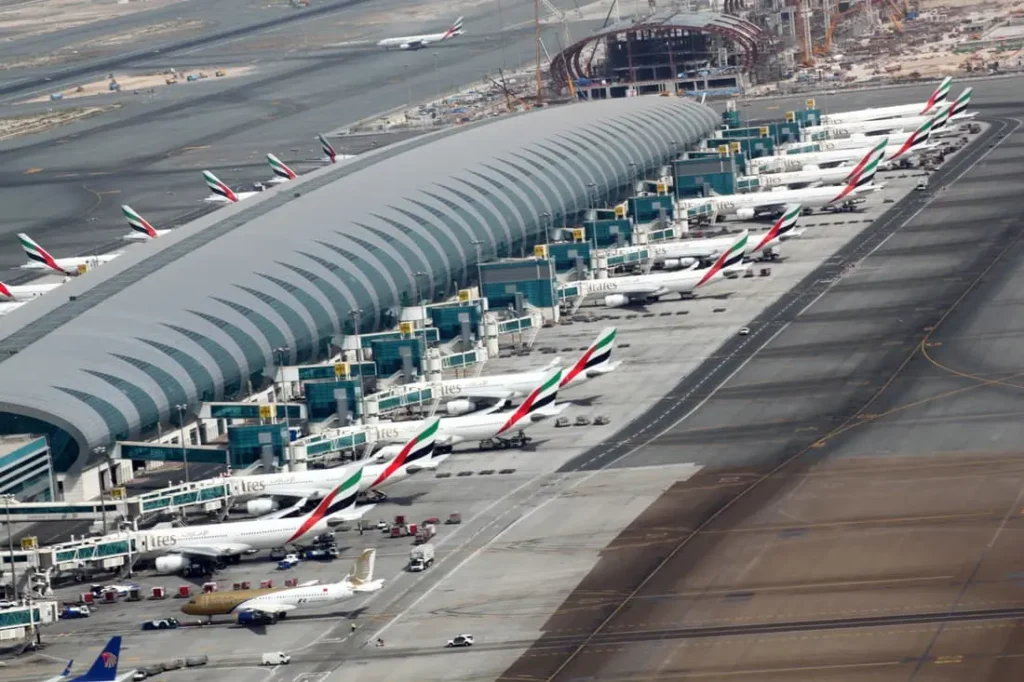
Length: 1,713 meters
Completion: 2008
Type: Airport Terminal
According to official Dubai Airports documentation, Terminal 3’s structural spine extends approximately 1.7 km.
Important note: Some analysts argue that because T3 integrates Concourse A, B, and C via structural connectors, measurements may vary depending on whether concourses are counted as part of the primary building mass.
2 Kansai International Airport Terminal 1 – Japan
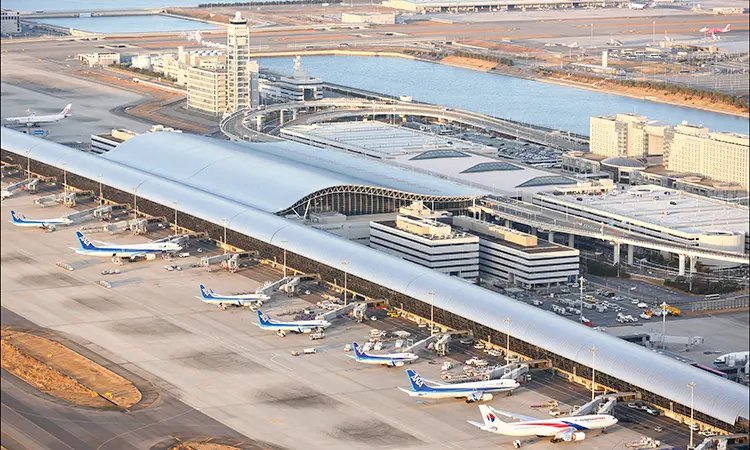
Length: 1,700 meters (curved structural arc)
Completion: 1994
Type: Airport Terminal
Designed by Renzo Piano, this terminal is one of the world’s most celebrated examples of aerodynamic airport architecture.
Measured along its structural arc, it is nearly equal in length to Dubai T3. Some architectural sources consider it the longest single continuous terminal hall, depending on classification methodology.
3 Changi Airport Terminal 3 – Singapore
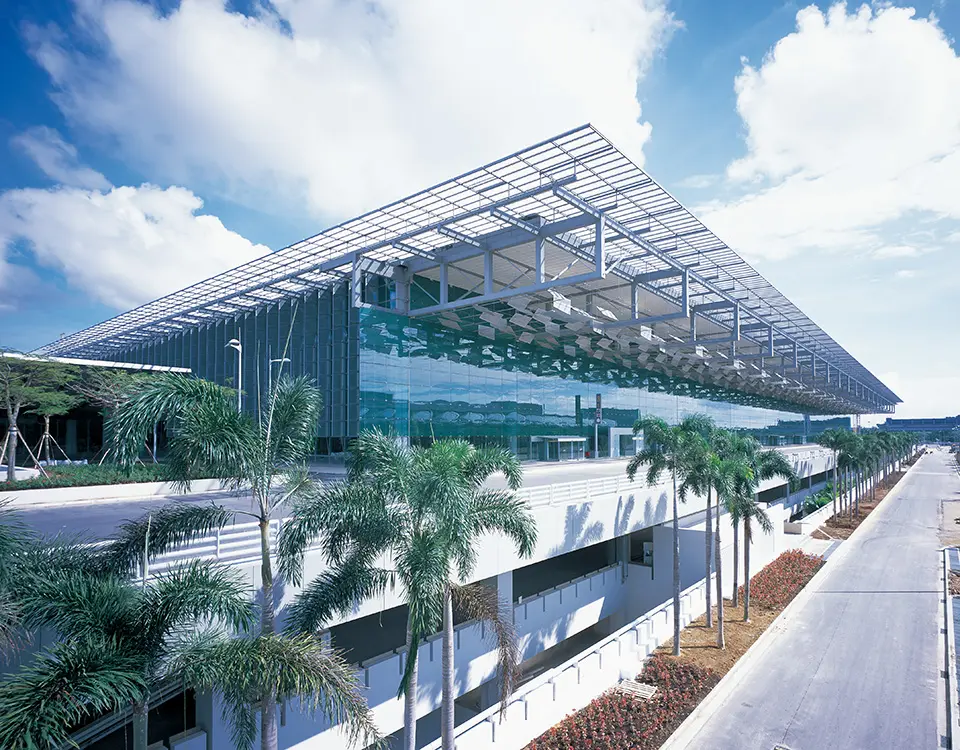
Length: 1,230 meters
Completion: 2008
Type: Airport Terminal
A highly linear passenger processing design built for expansion and optimized gate distribution.
4 Karl-Marx-Hof – Austria
Length: 1,100 meters
Completion: 1930
Type: Residential Housing
Located in Vienna, Karl-Marx-Hof is widely regarded as the longest continuous residential building in the world.
Unlike airport terminals, its length was driven by early 20th-century social housing policies emphasizing integrated community infrastructure.
5 Incheon International Airport Terminal 1 – South Korea
Length: 1,060 meters
Completion: 2001
Type: Airport Terminal
Linear gate configuration designed to maximize passenger throughput.
6 Beijing Daxing International Airport Terminal – China
Length: ~1,035 meters (maximum structural axis)
Completion: 2019
Type: Airport Terminal
Although radially designed, its maximum structural span qualifies under longest-axis measurement.
7 Boeing Everett Factory – USA
Length: ~1,025 meters (longest structural side)
Completion: 1967
Type: Aircraft Manufacturing
While globally famous as the largest building by volume, its longest single façade measures approximately 1 km.
Earlier claims of 1,600 meters often refer to complex-wide dimensions rather than a single continuous façade.
8 Masjid al-Haram Expansion – Saudi Arabia
Length: 1,000+ meters (expansion wing)
Completion: 2011
Type: Religious Complex
The expansion significantly increased pilgrimage capacity, creating one of the world’s most extensive continuous religious structures.
9 CentralWorld – Thailand
Length: 800+ meters (connected retail mass)
Completion: 2006
Type: Retail Complex
One of Southeast Asia’s largest integrated shopping structures built as a unified complex.
10 Madrid Barajas Terminal 4 – Spain
Length: 760 meters
Completion: 2006
Type: Airport Terminal
Recognized for its iconic wave-like timber roof and extended linear boarding hall.
4. Visual Comparison
📊 Bar Chart
Title: Top 10 Longest Buildings in the World
A horizontal bar chart comparing all ten buildings by length in meters clearly illustrates the sharp dominance of major airport terminals.
📍 Geographic Distribution Map
Title: Geographic Distribution of World’s Longest Buildings
Concentration regions:
- Middle East
- East Asia
- Europe
- North America
Airport infrastructure dominates the ranking.
5. Beyond Length: How Design & Function Influence Building Size
Why are airport terminals so dominant?
Airports
They require:
- Long aircraft docking corridors
- Linear security processing
- Efficient passenger flow
- Modular expansion capability
Residential Mega-Blocks
Buildings like Karl-Marx-Hof reflect social policy and urban density planning rather than transit efficiency.
Industrial Complexes
Factories prioritize assembly line continuity and large uninterrupted spans.
Horizontal vs Vertical Architecture
Skyscrapers solve land scarcity through height.
Long buildings solve operational complexity through linear organization.
Length is typically functional, not symbolic.
6. Data Notes & Methodology
To maintain accuracy:
✔ Verified measurements across multiple official publications
✔ Excluded perimeter and campus-wide figures
✔ Used façade-to-façade structural measurements
✔ Applied rounding to nearest 5 meters
Measurement Caveats
- Curved buildings measured along structural arc
- Radial terminals measured by maximum structural axis
- Concourse integration may affect interpretation
Where conflicting data appeared, official authority documentation was prioritized.
7. Frequently Asked Questions (FAQ)
1. What is the longest building in the world?
As of 2026, Dubai International Airport Terminal 3 is commonly cited at 1,713 meters. However, some architectural analysts argue Kansai Terminal 1 may qualify as the longest single uninterrupted terminal hall depending on classification.
2. How is building length measured?
By maximum continuous structural façade span, not walking distance or campus size.
3. Is the longest building the same as the tallest?
No. Tallest buildings are ranked by height (e.g., Burj Khalifa).
4. Does length include annexes?
Only if structurally continuous and architecturally integrated.
5. Are factories included?
Yes, if they meet the continuity requirement (e.g., Boeing Everett Factory).
6. Which country appears most frequently?
Airport-heavy nations such as the UAE, Japan, South Korea, and China dominate.
7. Are malls counted?
Yes, if they are architecturally unified structures.
8. Do curved buildings qualify?
Yes. Measured along structural arc.
9. Has the ranking changed historically?
Yes, particularly due to airport expansions in Asia and the Middle East.
10. Why aren’t skyscrapers included?
Because this ranking evaluates horizontal span, not height.
8. Conclusion
The world’s longest buildings redefine architectural scale. Rather than reaching upward, they stretch outward — driven by transportation systems, industrial production, residential planning, and religious gatherings.
As global mobility expands and infrastructure scales up, airport terminals and mega-complexes will likely continue pushing the boundaries of horizontal architecture.
9. Data Sources
- Dubai Airports Official Reports — https://www.dubaiairports.ae
- Kansai International Airport Company — https://www.kansai-airport.or.jp
- Changi Airport Annual Reports — https://www.changiairport.com
- Vienna Municipal Housing Archive (Karl-Marx-Hof) — https://www.wien.gv.at
- Incheon International Airport Authority — https://www.airport.kr
- Beijing Daxing International Airport — https://www.bdia.com.cn
- Boeing Commercial Airplanes — https://www.boeing.com
- Saudi Ministry of Hajj Infrastructure Reports — https://www.haj.gov.sa
- World Architecture Community — https://worldarchitecture.org
- Architectural Review — https://www.architectural-review.com