
Top 10 Countries with most Inventions
Contents
- 1 Introduction — Invention: The Invisible Engine Driving the Future
- 2 Methodology (Transparent Explanation)
- 3 Ranking (Top Ten Countries, Sorted by “Comprehensive Inventiveness Score”)
- 4 Country Analysis (Interpreted per country across three dimensions: Patents / R&D / Environment)
- 5 Why Have These Countries Become “Invention Powerhouses”?
- 6 Trend Prediction: Possible Changes in the Invention Landscape Over the Next 5 Years
- 7 Data Sources
Introduction — Invention: The Invisible Engine Driving the Future

Every invention, from the early electric light bulb and steam engine to today’s chips, AI algorithms, and clean energy equipment, bears witness to human societal progress. For a country, sustained “invention output” not only demonstrates its scientific research strength but also represents its industrial upgrading and future competitiveness. This article, referencing patent and innovation indices and integrating the three key dimensions of R&D investment, intellectual property output, and commercialization capability, compiles a list of the ten top-performing countries in the field of “invention.” It also interprets, from a warm narrative perspective, how these countries turn “ideas” into “products” that serve the world.
Methodology (Transparent Explanation)
Indicator Dimensions:
Intellectual Property Output: Includes number of patent applications, new patents granted, number of patents in force. Data sources: WIPO / World Intellectual Property Indicators (WIPI), Statista, etc.
R&D Investment and Personnel: National investment in R&D as a proportion of GDP, researchers per 10,000 people, number of industry-academia collaborations. Data sources: Global Innovation Index (GII), OECD Research & Development Statistics.
Innovation Environment and Commercialization Capability: Indicators include high-tech export turnover share, vitality of technology-intensive clusters, innovation ecosystem dynamism. Data sources: Techopedia, VisualCapitalist.
Ranking Criteria Explanation:
As the definition of “invention” is broad (encompassing mechanical, biological, electronic inventions, etc.), this article uses “Patents + Innovation Index” as an approximate measure. The listed countries are those leading overall in these indicators in recent years, with publicly verifiable data. The ranking might adjust if refined to “sheer number of inventions” or “number of high-value patents.”
Data Timeframe:
Most data is the latest available for 2023-2024. Values used in the article are approximations.
Ranking (Top Ten Countries, Sorted by “Comprehensive Inventiveness Score”)
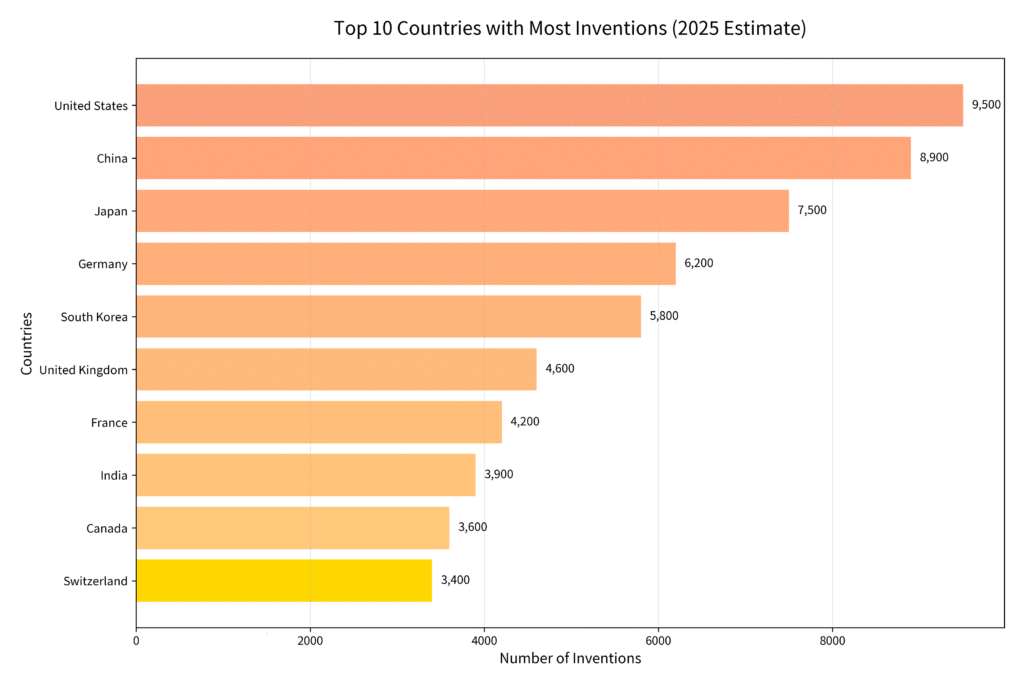
Note: The order below reflects the comprehensive assessment based on the above methodology in this article, not a sole authoritative ranking.
- United States — Dense patent output + world-leading research and industry translation ecosystem.
- China — Patent application volume has surged significantly in recent years, with rapid growth of the innovation ecosystem.
- Japan — Long-standing significant advantages in precision machinery, electronics, and chemical inventions.
- Germany — Engineering powerhouse + manufacturing integrated with an innovation system, continuously producing inventions.
- South Korea — Rapid growth in inventions in semiconductors, consumer electronics, and new energy batteries.
- Switzerland — Although small in population, leads the world in patent density, innovation investment, and high-value technology inventions.
- Netherlands — Excels in high-tech agriculture, biomedical, and materials science inventions.
- Finland — Mature Nordic innovation system, strong invention capability in communications, ICT, and clean energy technologies.
- Israel — Although small in scale, renowned for its high density of startups and high-tech invention rate.
- France — Continuous investment and output in invention fields like aerospace, biomedicine, and artificial intelligence.
Country Analysis (Interpreted per country across three dimensions: Patents / R&D / Environment)
United States
Patent Output: Approximately 3.3 million patents in force as of 2022.
R&D and Personnel: High R&D investment, strong university-industry cooperation, vibrant startup ecosystem.
Environment and Commercialization: Vast innovation ecosystems like Silicon Valley, Boston, Austin; inventions often move from lab to market. Warmer Perspective: In the US, a prototype built by a student in a garage can become a product used worldwide—from smart manufacturing beginnings to changing the world.
China

Patent Output: Approximately 695,400 invention patent applications in China in 2022.
R&D and Personnel: Expanding higher education, rapidly growing number of researchers, strong state support.
Environment and Commercialization: Explosion of inventions in manufacturing, digital, clean energy fields; innovation ecosystem transitioning from catching up to challenging. Warmer Perspective: In China, an engineer might turn a rural need into a device invention, then through exports, let the world also see the power of this “idea.”
Japan
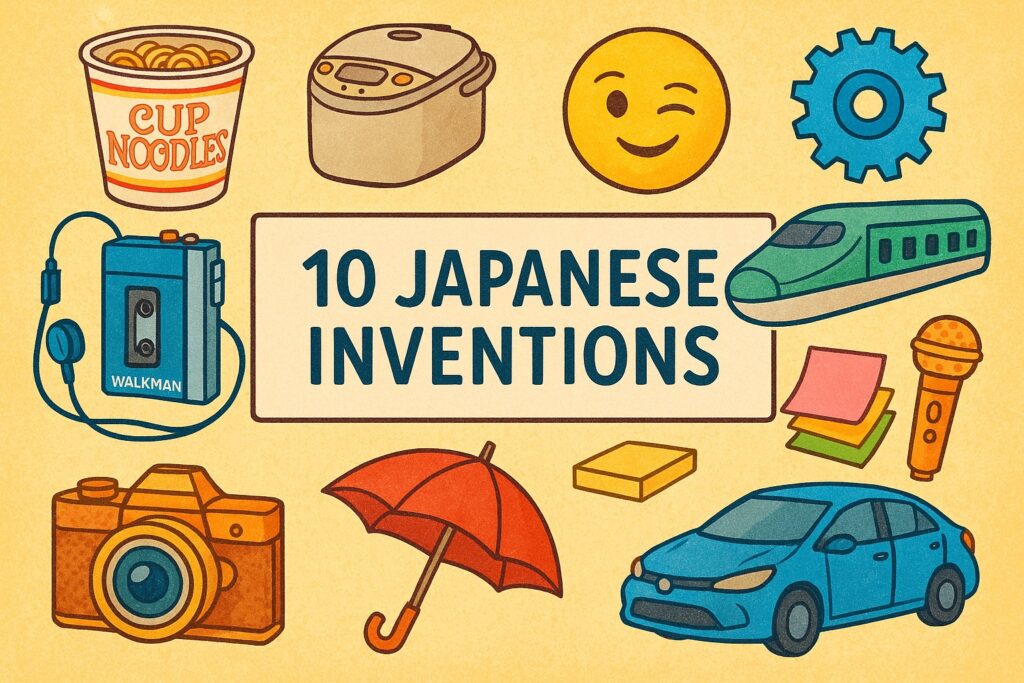
Patent Output: Approximately 2 million patents currently in force. R&D and Personnel: Strong engineering education, complete industrial chains, close integration of invention and manufacturing. Environment and Commercialization: Long-term leadership in robotics, automotive, and materials inventions. Warmer Perspective: In the suburbs of Tokyo, a small company might invent the next-generation sensor system, later mass-produced by a major manufacturer for the global market.
Germany
Patent Output: Consistently ranks among the top filers at the European Patent Office.
R&D and Personnel: Strong engineering culture, medium-sized enterprises (Mittelstand) are a key source of inventions.
Environment and Commercialization: Combination of manufacturing + R&D enables faster translation of inventions from lab to factory. Warmer Perspective: In a Bavarian town, a family-owned company might develop an energy-saving device, attracting visits from global manufacturers.
South Korea
Patent Output: Rapid increase in inventions in semiconductors, displays, and batteries.
R&D and Personnel: Large tech conglomerates + national policies driving innovation.
Environment and Commercialization: Numerous technology-intensive inventions, short commercialization cycles. Warmer Perspective: In Seoul, a new material designed by a graduate student might become part of a phone case—a “design” in hand turning into the “touch” for millions of users.
Switzerland
Patent Output: Filed 9,008 Swiss origin inventions with the EPO in 2022, ranking among the top.
R&D and Personnel: High integration of education, research, and industry; world-leading per capita patent indicators.
Environment and Commercialization: Renowned for high-value medical, pharmaceutical, and precision instrument inventions. Warmer Perspective: In a Zurich laboratory, a new biological detection technology might become the next global standard.
Netherlands
Patent Output: Growing annual inventions in biomedicine, materials science, and agricultural technology.
R&D and Personnel: Ranked 8th in the 2024 GII ranking.
Environment and Commercialization: Strong international connections, mature innovation incubation system. Warmer Perspective: In Amsterdam, an agricultural sensor device invented by a student might help farms reduce pesticide use by tons and reach the global market.
Finland
Patent Output: Close integration between education system and corporate R&D.
R&D and Personnel: Mature Nordic innovation system, prominent inventions in communications and ICT.
Environment and Commercialization: Strong capability in clean energy technology inventions. Warmer Perspective: In Helsinki, a robot design might originate from a student’s project, later adopted by an industrial robotics company.
Israel
Patent Output: Known for inventions in security communications, biotechnology, and agricultural technology.
R&D and Personnel: High startup density, rapid technology transfer, despite small population.
Environment and Commercialization: Fast-paced tech commercialization environment. Warmer Perspective: In Tel Aviv, a young team might code the next disaster prevention sensor late at night, before taking it global.
France
Patent Output: Good growth rate in aerospace, biomedicine, and AI inventions.
R&D and Personnel: Strong fundamentals in research.
Environment and Commercialization: Potential in high-value inventions (e.g., medical devices), though overall scale slightly lower than US/China. Warmer Perspective: In Paris, a new medical imaging device invented through collaboration between a designer and an engineer might save tens of thousands of patients in countries worldwide.
Why Have These Countries Become “Invention Powerhouses”?
• Strong R&D Investment + Talent Pool: Inventions rely on laboratories and research teams; leading countries invest heavily in this area.
• Sound Intellectual Property System + Unblocked Commercialization Channels: Countries with smooth pathways from patent filing, incubation, industrialization to export have stronger invention output.
• Complete Industrial Ecosystem + Innovative Culture: Manufacturing, tech industry, and startup ecosystems collectively support the rapid grounding of “ideas” into “products.”
Trend Prediction: Possible Changes in the Invention Landscape Over the Next 5 Years
• Invention output from China, Japan, and South Korea will continue to grow, especially in AI, clean energy, and new materials.
• Europe will follow a “small but refined” path, with countries like Switzerland, the Netherlands, and Finland continuing to exert strength in high-value niche sectors.
• The value of inventions will shift from “quantity” to “quality”—high-value patents and high-impact inventions becoming the new standard.
• The global invention network will become more collaborative, with transnational co-invention and open innovation becoming the norm.
Data Sources
World Intellectual Property Indicators (WIPI) — WIPO.(turn0search11)
Statista — (turn0search9)
Global Innovation Index (GII) 2024/2025 — WIPO & partners.(turn0search10)
Techopedia — “Most Innovative Countries”(turn0search6)
OECD / EPO