Top 10 Highest Buildings in the World 2026: The Tallest Skyscrapers Ranked
There is a particular feeling that comes from standing at the foot of a very tall building. The street noise seems to fall away for a second. Your head tilts back. The glass keeps going, then going again, until the tower feels less like an object and more like a line drawn between the city and the sky.
The highest buildings in the world are not simply feats of height. They are stories of growing cities, national ambition, engineering patience, and the human habit of looking upward. For this ranking, we use official architectural height from The Skyscraper Center, maintained by CTBUH / Council on Vertical Urbanism, which counts permanent architectural features such as spires but excludes antennas, signage, flagpoles, and other functional equipment. Only completed buildings are included.
Contents
- 1 Top 10 Highest Buildings in the World at a Glance
- 2 1. Burj Khalifa, Dubai
- 3 2. Merdeka 118, Kuala Lumpur
- 4 3. Shanghai Tower, Shanghai
- 5 4. Makkah Royal Clock Tower, Mecca
- 6 5. Ping An Finance Center, Shenzhen
- 7 6. Lotte World Tower, Seoul
- 8 7. One World Trade Center, New York City
- 9 8. Guangzhou CTF Finance Centre, Guangzhou
- 10 8. Tianjin CTF Finance Centre, Tianjin
- 11 10. CITIC Tower, Beijing
- 12 What Makes These Buildings Different?
- 13 Frequently Asked Questions
- 14 Final Thoughts
- 15 References and Data Sources
Top 10 Highest Buildings in the World at a Glance
| Rank | Building | City, Country | Height | Floors | Completed |
|---|---|---|---|---|---|
| 1 | Burj Khalifa | Dubai, United Arab Emirates | 828 m / 2,717 ft | 163 | 2010 |
| 2 | Merdeka 118 | Kuala Lumpur, Malaysia | 679 m / 2,227 ft | 118 | 2023 |
| 3 | Shanghai Tower | Shanghai, China | 632 m / 2,073 ft | 128 | 2015 |
| 4 | Makkah Royal Clock Tower | Mecca, Saudi Arabia | 601 m / 1,972 ft | 120 | 2012 |
| 5 | Ping An Finance Center | Shenzhen, China | 599 m / 1,965 ft | 115 | 2017 |
| 6 | Lotte World Tower | Seoul, South Korea | 555 m / 1,819 ft | 123 | 2017 |
| 7 | One World Trade Center | New York City, United States | 541 m / 1,776 ft | 94 | 2014 |
| 8 | Guangzhou CTF Finance Centre | Guangzhou, China | 530 m / 1,739 ft | 111 | 2016 |
| 8 | Tianjin CTF Finance Centre | Tianjin, China | 530 m / 1,739 ft | 97 | 2019 |
| 10 | CITIC Tower | Beijing, China | 528 m / 1,731 ft | 109 | 2018 |
1. Burj Khalifa, Dubai
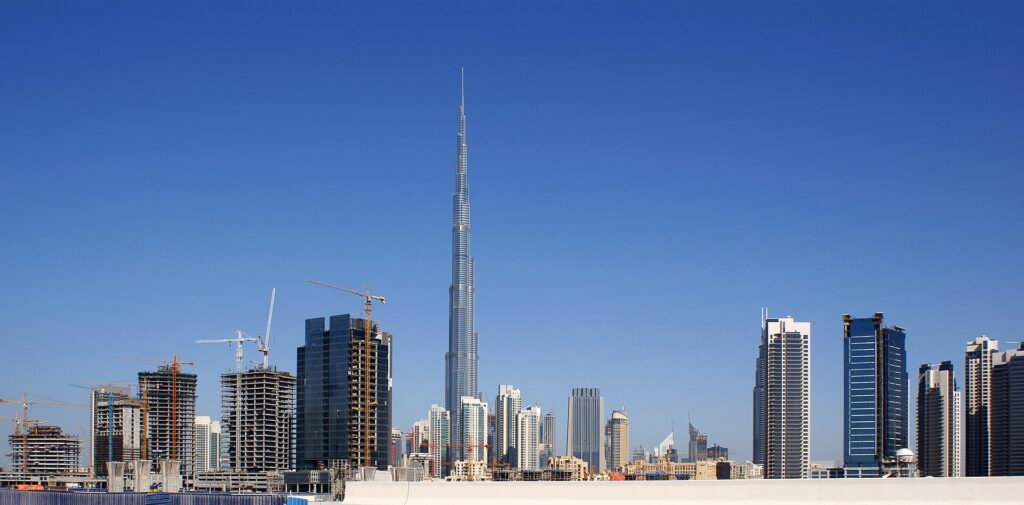
At 828 meters, Burj Khalifa is still the tallest building in the world in 2026. It is also the only completed building above 800 meters, which explains why it continues to feel almost alone at the top of the ranking.
Designed by Skidmore, Owings & Merrill and completed in 2010, the tower uses a Y-shaped, buttressed core form that helps it resist wind while tapering gracefully into the desert sky. Inside are offices, residences, the Armani Hotel, restaurants, and observation decks. But the emotional power of Burj Khalifa is simpler than that: it changed what people thought a city skyline could look like.
2. Merdeka 118, Kuala Lumpur
Merdeka 118 is the newest giant in the top three, rising to 679 meters above Kuala Lumpur. Its name carries deep national meaning: “Merdeka” means independence, and the tower stands near Stadium Merdeka, where Malaysia’s independence was declared in 1957.
Its faceted glass body and long architectural spire make it instantly recognizable. The tower includes hotel, serviced apartment, office, and observation uses, placing it firmly in the modern mixed-use skyscraper tradition. In a city already famous for the Petronas Twin Towers, Merdeka 118 adds a new vertical landmark to Malaysia’s skyline.

3. Shanghai Tower, Shanghai
Shanghai Tower reaches 632 meters, making it China’s tallest building and one of the world’s rare megatall skyscrapers. Its twisting form is not only beautiful; it is also practical. The curved, rotating shape helps reduce wind loads, an important advantage for a tower of this scale.
The building stands in Lujiazui beside Jin Mao Tower and Shanghai World Financial Center, creating one of the most dramatic skyscraper clusters anywhere on Earth. Shanghai Tower feels like a vertical city: offices, hotel space, retail areas, and observation levels are stacked into a form that seems to turn with the river and the weather.

4. Makkah Royal Clock Tower, Mecca
The Makkah Royal Clock Tower, also known as the Abraj Al-Bait Clock Tower, rises 601 meters above Mecca. It is not just one of the highest buildings in the world; it is also one of the most culturally significant, standing close to Masjid al-Haram, the holiest mosque in Islam.
Its enormous clock faces make the tower visible across the city, especially at night. The building includes hotel, serviced apartment, retail, and religious support functions, serving the millions of pilgrims who come to Mecca each year. Among the top 10, it is the tower most closely tied to ritual, movement, and gathering.
5. Ping An Finance Center, Shenzhen
At 599 meters, Ping An Finance Center is the tallest building in Shenzhen, a city that has become a global symbol of speed, technology, and economic transformation. Completed in 2017, the tower is almost as tall as the Makkah Royal Clock Tower, missing the 600-meter mark by only about one meter.
Its stainless-steel and glass exterior gives it a sharp, controlled presence. Unlike some mixed-use towers, Ping An Finance Center is primarily an office building, which suits Shenzhen’s identity as a working engine of finance, manufacturing, and innovation.
6. Lotte World Tower, Seoul
Lotte World Tower rises 555 meters above Seoul, with a pale, elegant profile that feels softer than many of the sharper towers on this list. Completed in 2017, it combines hotel, residential, office, and retail functions, along with public observation areas.
The tower’s design draws on Korean ceramic and calligraphy traditions, giving it a calm upward curve rather than a purely mechanical expression of height. It has become one of Seoul’s clearest modern landmarks: tall, polished, and visible from far across the city.
7. One World Trade Center, New York City
One World Trade Center stands 541 meters tall, or 1,776 feet, a number deliberately chosen to echo the year of American independence. It is the tallest building in the United States and the only U.S. tower in the global top 10.
Completed in 2014, the building carries a weight that no simple height ranking can fully explain. It is an office tower, an observation destination, and a symbol of rebuilding in Lower Manhattan. From the harbor, from Brooklyn, or from the streets around the memorial, its form is restrained but unmistakable.
.jpg?width=1200)
8. Guangzhou CTF Finance Centre, Guangzhou
Guangzhou CTF Finance Centre reaches 530 meters and shares the eighth position globally with Tianjin CTF Finance Centre. Completed in 2016, it is part of Guangzhou’s Zhujiang New Town skyline, one of the strongest modern business districts in southern China.
The tower includes hotel, residential, and office space, arranged in a clean vertical stack. Its terracotta detailing gives warmth to an otherwise highly technical glass-and-steel form, a reminder that tall buildings can still carry texture and regional character.
8. Tianjin CTF Finance Centre, Tianjin
Tianjin CTF Finance Centre also stands at 530 meters, creating a rare tie in the official top 10. Its rounded, tapering form looks almost fluid, especially compared with the hard-edged silhouettes of many financial towers.
Completed in 2019, the building includes hotel, serviced apartment, and office uses. It is an elegant example of wind-conscious design: the tower’s smooth curves help reduce vortex shedding, making the building both visually quiet and technically sophisticated.
10. CITIC Tower, Beijing
CITIC Tower, widely known as China Zun, rises 528 meters in Beijing’s Central Business District. Its nickname comes from the zun, an ancient Chinese ritual vessel whose broad-shouldered form inspired the tower’s profile.
Completed in 2018, CITIC Tower is the tallest building in Beijing. It works especially well as a closing entry for this list because it shows where the skyscraper has arrived: no longer only a race for height, but also a way for cities to translate history, identity, and business ambition into a single vertical shape.
What Makes These Buildings Different?
The current top 10 shows three clear patterns.
First, Asia dominates the ranking. China alone has four buildings in the top 10 if Guangzhou CTF, Tianjin CTF, Ping An Finance Center, and CITIC Tower are counted together. Add Malaysia and South Korea, and the center of skyscraper gravity is unmistakably in Asia.
Second, only four completed buildings exceed 600 meters: Burj Khalifa, Merdeka 118, Shanghai Tower, and Makkah Royal Clock Tower. That makes the word “megatall” genuinely rare, not just impressive-sounding.
Third, the ranking depends on official architectural height. This matters because permanent spires count, while antennas and temporary equipment do not. It is also why some older or simplified lists differ slightly, especially around the 8th to 11th positions.
Frequently Asked Questions
What is the highest building in the world in 2026?
The highest building in the world in 2026 is Burj Khalifa in Dubai, United Arab Emirates. It stands 828 meters, or 2,717 feet, tall.
What is the second highest building in the world?
The second highest building in the world is Merdeka 118 in Kuala Lumpur, Malaysia, at 679 meters, or 2,227 feet.
Why is Taipei 101 not in the top 10?
Taipei 101 is still one of the world’s most famous skyscrapers, but it ranks just outside the current top 10 by official architectural height. The 530-meter tie between Guangzhou CTF Finance Centre and Tianjin CTF Finance Centre keeps Taipei 101 out of the top 10.
Is Jeddah Tower included?
No. Jeddah Tower is not included because this ranking only counts completed buildings. If it is finished at its planned height of more than 1,000 meters, it would surpass Burj Khalifa.
Final Thoughts
The top 10 highest buildings in the world are measured in meters, but their real scale is larger than numbers. They mark where cities have placed their confidence: in finance, travel, faith, memory, technology, and national identity.
Seen from far away, they are skyline shapes. Seen up close, they are years of design decisions, foundation work, elevator systems, wind studies, glass panels, and human labor. And for the rest of us, looking up from the street, they remain one of the simplest reminders that cities are built not only outward, but also toward the sky.
References and Data Sources
This article was prepared using official architectural-height data and building records checked on April 29, 2026.
- The Skyscraper Center: Tallest Buildings, completed buildings in 2026
- The Skyscraper Center: Tall Building Criteria
- Council on Vertical Urbanism: History