World Biggest Building Top 10 in 2026: Largest Buildings Ranked
[cpstest_tools]
When people search for the world’s biggest building, they usually do not mean the tallest tower. They mean the building that feels almost too large to understand at street level: a structure that behaves like a district, a terminal, a market, or even a small city under one roof.
That is why this ranking focuses on floor area, not height. A building can dominate a skyline because it is tall, but it becomes truly gigantic when its interior square meters stretch so far that shops, hotels, offices, warehouses, transport systems, and public space all begin to merge into one continuous organism.
For this article, we use widely cited gross floor area figures for occupied buildings or connected building complexes intended for continuous human use. Because different organizations count connected halls, concourses, basements, or podiums in different ways, some older lists vary slightly. Where that happens, we follow the most commonly cited current figure from official operators, Guinness World Records, major architecture references, or long-established reference sources.
Contents
- 1 World Biggest Building Top 10 at a Glance
- 2 1. AvtoVAZ Main Assembly Building, Tolyatti
- 3 2. New Luosiwan International Trade City, Kunming
- 4 3. Dubai International Airport Terminal 3, Dubai
- 5 4. New Century Global Center, Chengdu
- 6 5. Abraj Al Bait Endowment, Mecca
- 7 6. Aalsmeer Flower Auction, Aalsmeer
- 8 7. CentralWorld, Bangkok
- 9 9. Surat Diamond Bourse, Surat
- 10 10. The Pentagon, Arlington
- 11 What Counts as the “Biggest” Building?
- 12 Frequently Asked Questions
- 13 Final Thoughts
- 14 References and Data Sources
- 15 Image Credits
World Biggest Building Top 10 at a Glance
| Rank | Building | Location | Floor Area | Main Use |
|---|---|---|---|---|
| 1 | AvtoVAZ Main Assembly Building | Tolyatti, Russia | 6,000,000 sq m / 64.6 million sq ft | Auto manufacturing |
| 2 | New Luosiwan International Trade City | Kunming, China | 3,140,000 sq m / 33.8 million sq ft | Wholesale trade complex |
| 3 | Dubai International Airport Terminal 3 | Dubai, United Arab Emirates | 1,713,000 sq m / 18.4 million sq ft | Airport terminal |
| 4 | New Century Global Center | Chengdu, China | 1,700,000 sq m / 18.3 million sq ft | Mixed-use retail, leisure, hotel |
| 5 | Abraj Al Bait Endowment | Mecca, Saudi Arabia | 1,575,815 sq m / 17.0 million sq ft | Hotel, retail, religious support |
| 6 | Aalsmeer Flower Auction | Aalsmeer, Netherlands | 999,000 sq m / 10.8 million sq ft | Flower auction and logistics |
| 7 | CentralWorld | Bangkok, Thailand | 830,000 sq m / 8.9 million sq ft | Retail, office, hotel |
| 8 | Berjaya Times Square | Kuala Lumpur, Malaysia | 700,000 sq m / 7.5 million sq ft | Retail, hotel, residences |
| 9 | Surat Diamond Bourse | Surat, India | 659,611 sq m / 7.1 million sq ft | Office and diamond trade |
| 10 | The Pentagon | Arlington, United States | 604,000 sq m / 6.5 million sq ft | Government offices |
1. AvtoVAZ Main Assembly Building, Tolyatti
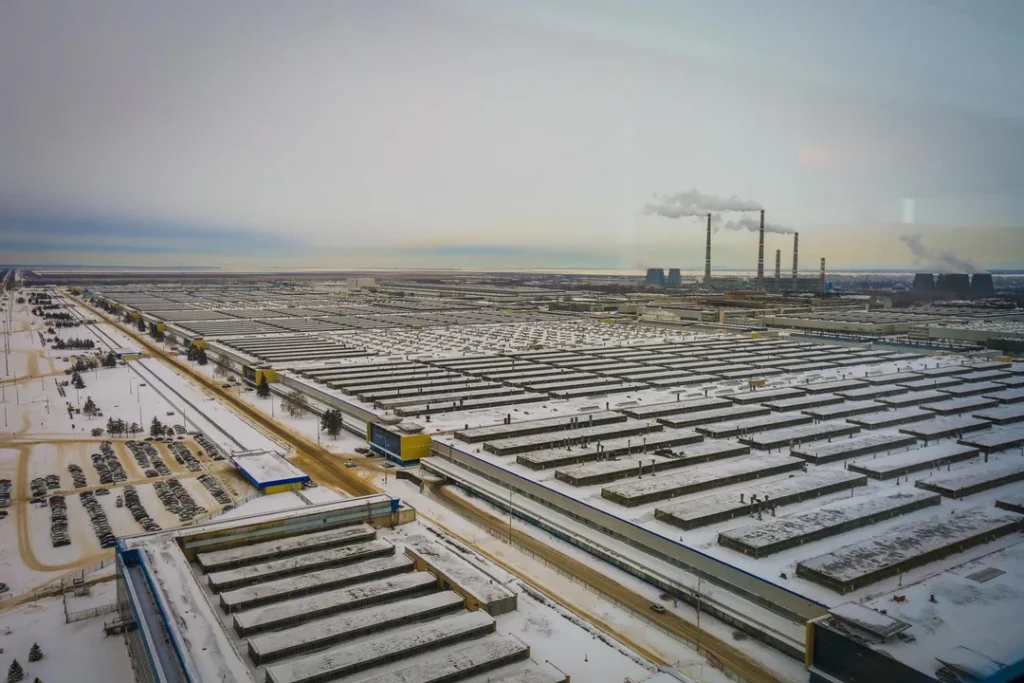
The biggest building on this list by floor area is the AvtoVAZ main assembly building in Tolyatti, Russia. It is not glamorous in the way a luxury mall or a landmark tower is glamorous. Its scale is industrial, repetitive, and almost abstract. But that is part of what makes it so fascinating. At around 6 million square meters, it turns automobile production into architecture on a nearly unimaginable scale.
This is the kind of building that changes how we think about the word “building.” It behaves more like an indoor manufacturing landscape than a single enclosed object. Readers looking for the world’s largest building are often surprised to see a factory take the top spot, but by usable floor area, that surprise is exactly the point.
2. New Luosiwan International Trade City, Kunming
New Luosiwan International Trade City is one of the biggest commercial wholesale complexes on Earth. With a commonly cited floor area of 3.14 million square meters, it was built to serve the logic of bulk trade rather than the logic of tourism or spectacle.
Its size reflects the scale of modern distribution networks in China. Wholesale markets rarely get the same global attention as airports, casinos, or skyscrapers, yet they are often the places where true building gigantism becomes most visible. New Luosiwan is a reminder that some of the world’s biggest structures exist to keep supply chains moving quietly in the background.
3. Dubai International Airport Terminal 3, Dubai
Dubai International Airport Terminal 3 is one of the clearest examples of a building designed to absorb movement at planetary scale. Its floor area is commonly given as 1,713,000 square meters, making it one of the largest airport terminal buildings in the world.
What makes Terminal 3 impressive is not only the raw number. It is the way that number is experienced. The building is all circulation: check-in halls, concourses, lounges, gates, retail space, security systems, baggage infrastructure, and connections that keep millions of travelers flowing through a single coordinated machine. It is a mega-building built entirely around velocity.
4. New Century Global Center, Chengdu
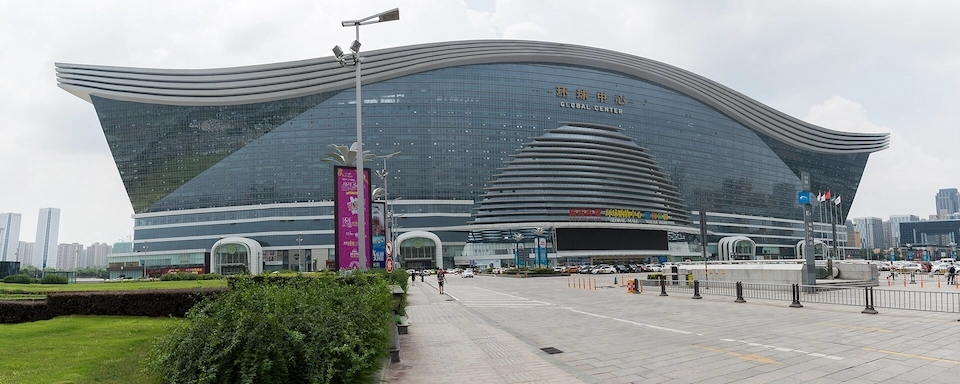
New Century Global Center is the most famous “big building” on the internet, and for good reason. It is enormous, surreal, and easy to picture. Inside are shopping areas, offices, hotels, conference space, entertainment venues, and a giant water-park environment that helped make the complex instantly newsworthy when it opened.
Its widely cited floor area is about 1.7 million square meters, and that sheer size is paired with a dramatic visual personality. Unlike many mega-buildings that hide their scale behind logistics or security, New Century Global Center almost performs its size in public. It wants to be seen as excessive, and that theatrical quality is part of its global appeal.
5. Abraj Al Bait Endowment, Mecca
Abraj Al Bait combines monumental size with unusual cultural importance. The complex rises beside Masjid al-Haram and supports one of the most important pilgrimage destinations in the world. With around 1,575,815 square meters of floor area, it belongs on any serious list of the largest buildings on Earth.
It is also one of the easiest buildings on this list to recognize. The giant clock faces give it a symbolic clarity that many large complexes do not have. But behind that famous exterior is a building system designed to handle pilgrims, hospitality, shopping, and religious travel at extraordinary scale.
6. Aalsmeer Flower Auction, Aalsmeer
The Aalsmeer Flower Auction building in the Netherlands is one of those structures that becomes more amazing the more practical it sounds. Flowers are delicate, perishable, seasonal, and globally distributed. Bringing that trade into one coordinated physical system requires staggering spatial scale, which is why Aalsmeer is regularly cited among the largest buildings in the world.
At roughly 999,000 square meters, it is less about spectacle than choreography. Goods arrive, are sorted, sold, redistributed, and moved out again with remarkable speed. It is a building shaped by time pressure as much as by size, and that makes it one of the most operationally interesting entries in this ranking.
7. CentralWorld, Bangkok
CentralWorld shows how “biggest building” can also mean intensity. With about 830,000 square meters of retail-led floor area, it is not just a shopping center but a dense urban complex that pulls together stores, food, event space, offices, and hospitality in the center of Bangkok.
Many giant buildings feel isolated from city life because they are so large. CentralWorld does the opposite. It sits inside the pulse of Bangkok and turns scale into public energy. That makes it one of the most reader-friendly examples on this list: people can immediately imagine what it means for a building to become a piece of everyday city life.8. Berjaya Times Square, Kuala Lumpur
Berjaya Times Square remains one of Southeast Asia’s signature mega-complexes. With a gross built-up area of about 7.5 million square feet, or roughly 700,000 square meters, it combines a vast shopping mall with hotel, residential, office, parking, and indoor entertainment functions.
What makes it memorable is its mixed-use layering. This is not just one big box with tenants inside. It is an urban stack, a place where retail, hospitality, leisure, and vertical living are compressed into a single oversized development. In that sense, it bridges the gap between the supermall and the megastructure.
9. Surat Diamond Bourse, Surat
Surat Diamond Bourse is one of the newest headline-making entries among the world’s largest buildings. Guinness World Records reported in 2023 that it surpassed the Pentagon as the world’s largest office building, with 659,611 square meters of floor space.
That matters because it shows how the geography of large office complexes is changing. Instead of a twentieth-century government headquarters defining the category, a twenty-first-century trade hub in India now holds the office-building record. It is a useful example of how “biggest” is never just a number. It also tells us where economic momentum is concentrating.
10. The Pentagon, Arlington
The Pentagon was once the classic answer to the question, “What is the biggest office building in the world?” Even after losing that particular title, it remains one of the largest and most famous buildings on Earth, with around 604,000 square meters of floor area.
Its importance in global imagination comes from more than size. The Pentagon is instantly legible in plan, symbol, and function. For decades, it defined what an enormous administrative building could be. Today it closes this top 10 not because it has become small, but because the global scale of architecture around it has become even larger.
What Counts as the “Biggest” Building?
This question matters more than most ranking articles admit.
If you measure by height, Burj Khalifa is the answer. If you measure by usable volume, Boeing’s Everett factory is the standard record-holder. If you measure by floor area, the answer changes completely and the list fills with factories, trade centers, transport terminals, and giant mixed-use complexes.
That is why the keyword world biggest building can be confusing. In everyday English, “biggest” often means the building with the most interior space people can actually use. For search intent, floor area is usually the best fit.
Frequently Asked Questions
What is the biggest building in the world in 2026?
By widely cited floor area, the AvtoVAZ main assembly building in Tolyatti, Russia is commonly listed as the biggest building in the world.
What is the largest building in the world by volume?
By usable volume, Guinness World Records identifies the Boeing Everett factory in Washington, United States as the world’s largest building.
Is Burj Khalifa the biggest building in the world?
Burj Khalifa is the tallest building in the world, not the biggest by floor area. “Tallest” and “biggest” are different rankings.
What is the biggest office building in the world now?
Surat Diamond Bourse in Surat, India is the current headline holder as the world’s largest office building, surpassing the Pentagon according to Guinness World Records in 2023.
Why do some biggest-building lists look different?
They differ because some sources count connected concourses, podiums, logistics halls, or multi-tower complexes differently. That is why methodology matters as much as the raw numbers.
Final Thoughts
The world’s biggest buildings are not all beautiful in the same way, and that is exactly what makes them interesting. Some are civic symbols. Some are trade machines. Some are indoor cities built around shopping, pilgrimage, travel, or logistics. Their sizes are impressive, but the more revealing story is what that size is for.
In the end, the biggest buildings in the world tell us where modern life concentrates its energy: manufacturing, transport, religion, retail, administration, and global commerce. They are not simply large roofs over large rooms. They are physical maps of what a society chooses to scale.
References and Data Sources
This article was prepared using publicly accessible sources checked on May 25, 2026. Because floor-area methodologies can differ across operators and older reference lists, the figures above follow the most widely cited current values available from official pages, Guinness World Records, architecture references, and established reference sources.
- Guinness World Records: Most capacious building
- Guinness World Records: Surat Diamond Bourse surpasses the Pentagon
- The Skyscraper Center: AvtoVAZ
- Central Pattana: CentralWorld property detail
- Berjaya Assets: Berjaya Times Square
- Britannica: Abraj al-Bayt
- Wikipedia: New Century Global Center
- Wikipedia: Dubai International Terminal 3
- Wikipedia: Aalsmeer Flower Auction
- Wikipedia: The Pentagon